


Climate Resilience and Children’s Nature Connection: A Toolkit
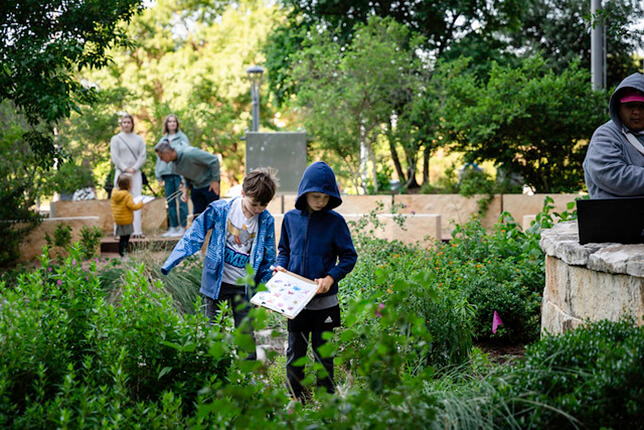
Austin Public Library has gardens and natural vegetation around the library. They use it as a way to support children's programming around nature while also using it as a space for exploration and connections.Nature-Smart Library in Austin, Texas. Photo by City of Austin and Austin Public Library.
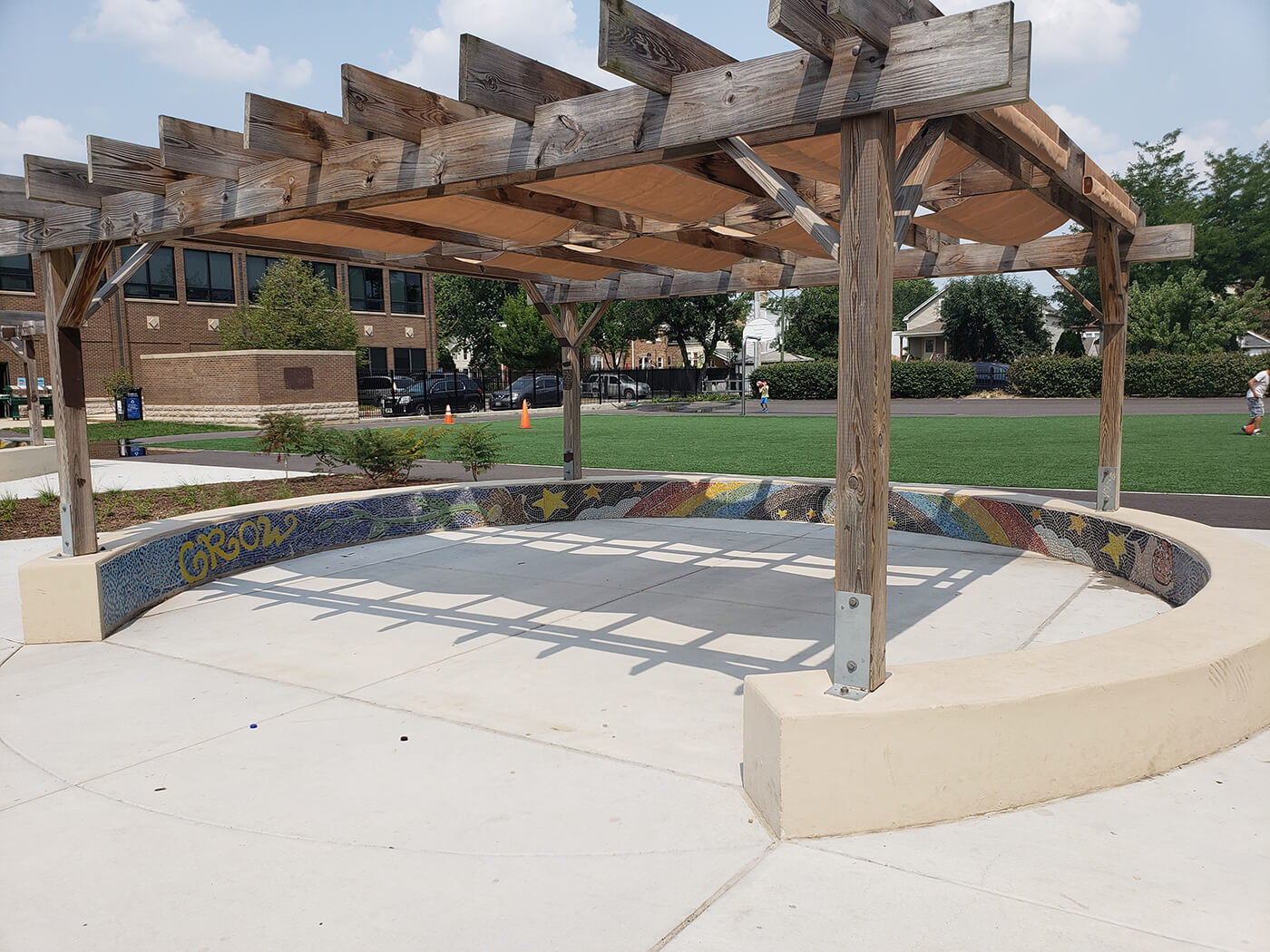
Davis Elementary's re-designed schoolyard supports Space to Grow's three main goals of managing stormwater, creating outdoor classrooms and gardens, and providing health and wellness opportunities.Davis Elementary School in Chicago, Illinois. Photo by Space to Grow.
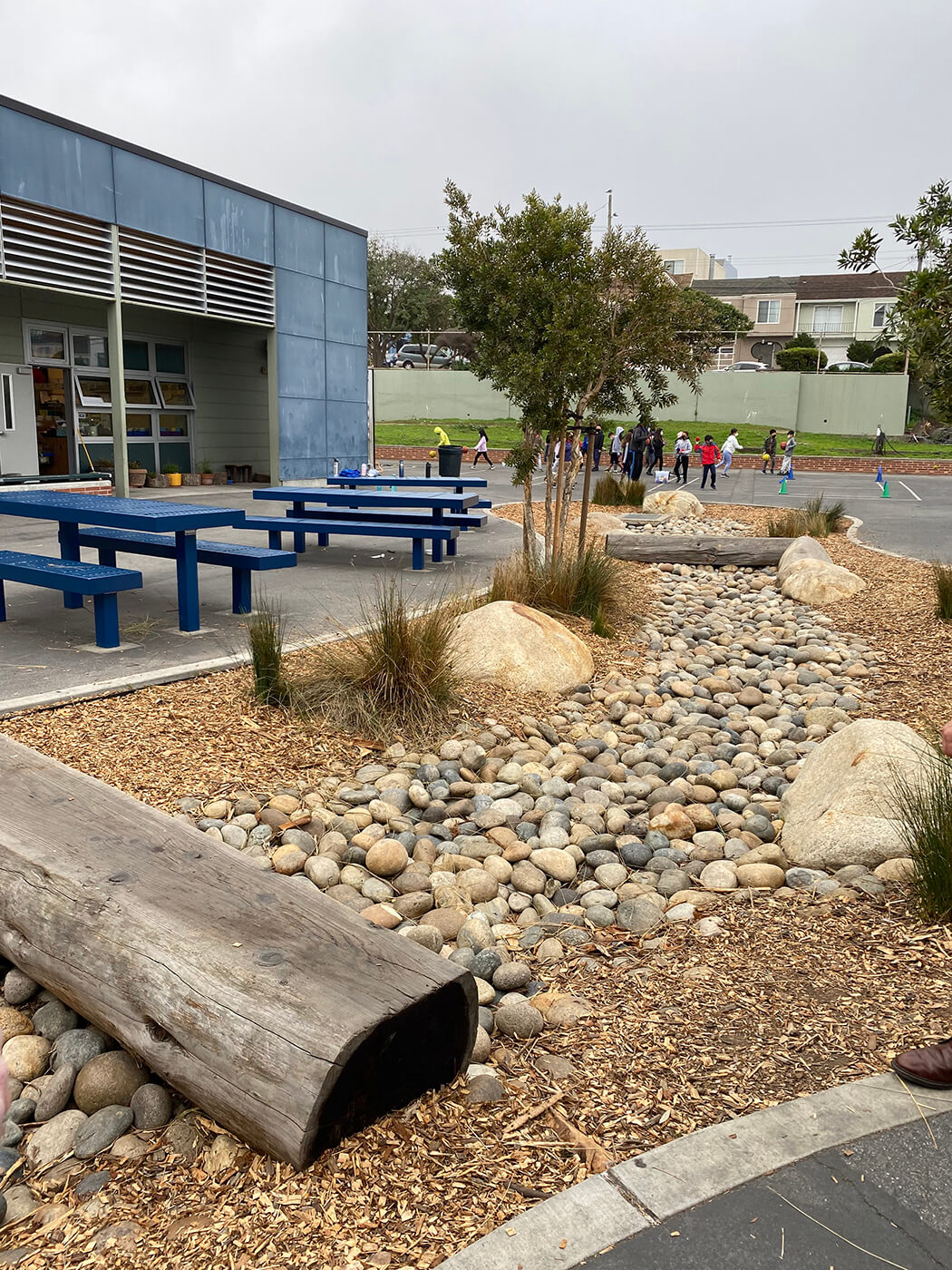
San Francisco Public Utilities Commission (SFPUC) first started its partnership with the San Francisco Unified School District (SFUSD) in 2009 to work on stormwater capture on schoolyards. This strong partnership remains and has led to multiple transformations throughout the school district, benefiting students, teachers and communities. Read more about their trajectory in the Implementing Green Stormwater Infrastructure on Schoolyards report.Davis Elementary School in San Francisco, California. Photo by San Francisco Unified School District.
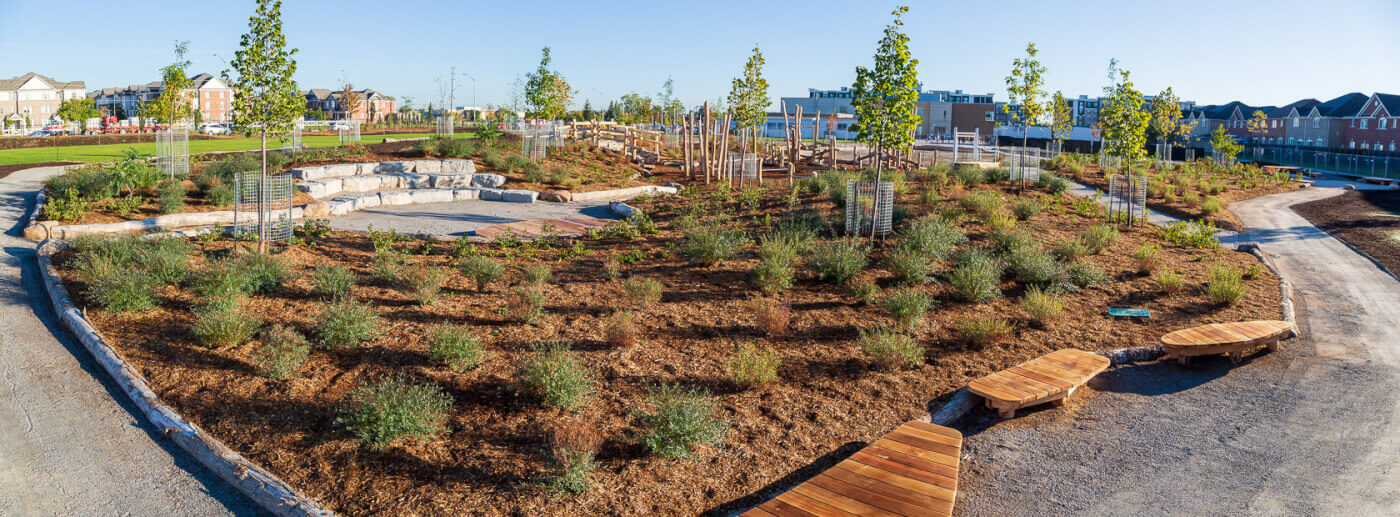
In collaboration with Berlin-based landscape architect, Birgit Teichmann, along with local Canadian landscape architects, the Irma Coulson Public School Pilot integrates lessons from Berlin’s Sponge Schools project, designed to ensure that school grounds can absorb 100% of rainfall on the school site, while mitigating flood risk in their neighborhoods.Irma Coulson Public School in Milton, Ontario. Photo by Evergreen.
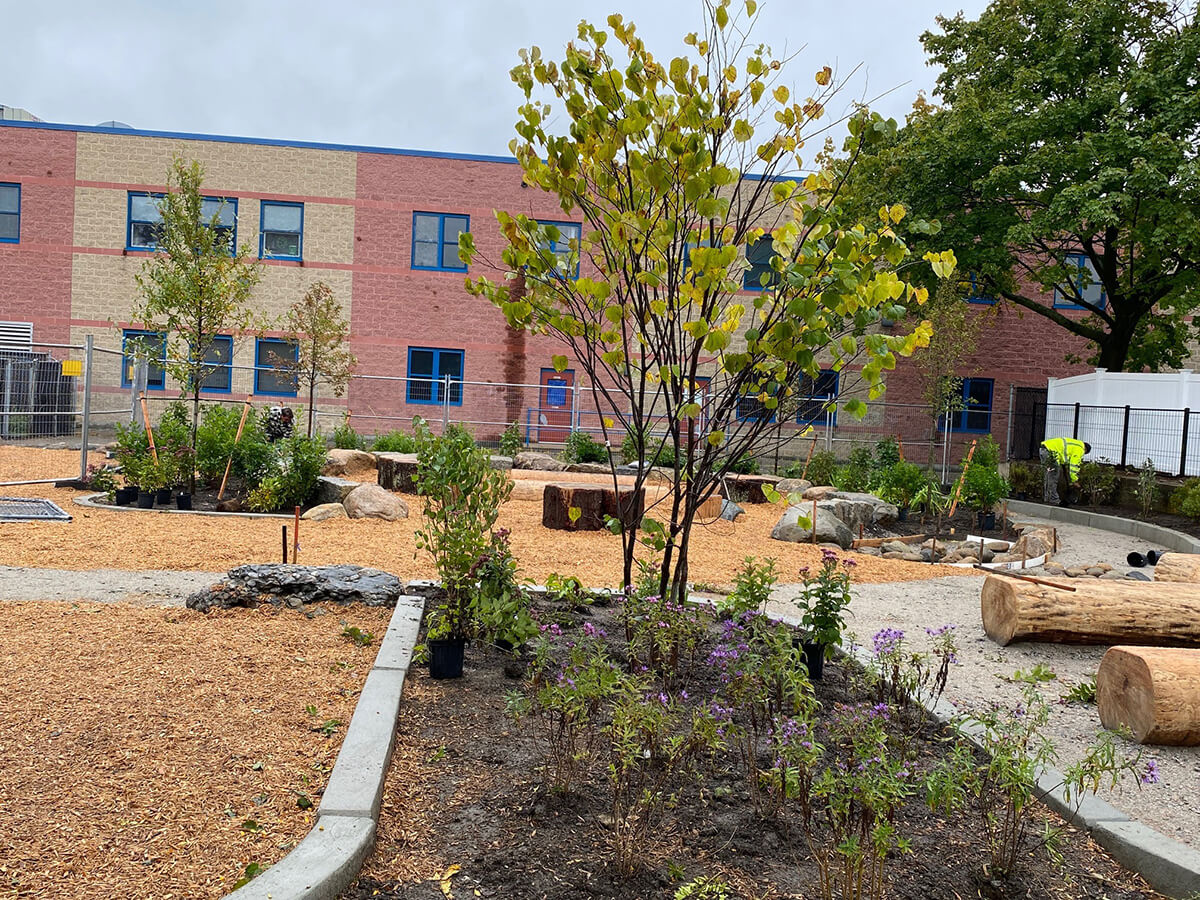
The Bailey Baxter Green Schoolyard is a flagship project of the Providence Green Schoolyard Initiative. This re-designed space includes walking paths, as well as the planting of new trees and greenery that support stormwater capture to mitigate flooding.Bailey Baxter Green Schoolyard in Providence, Rhode Island. Photo by Rachel Newman Greene.
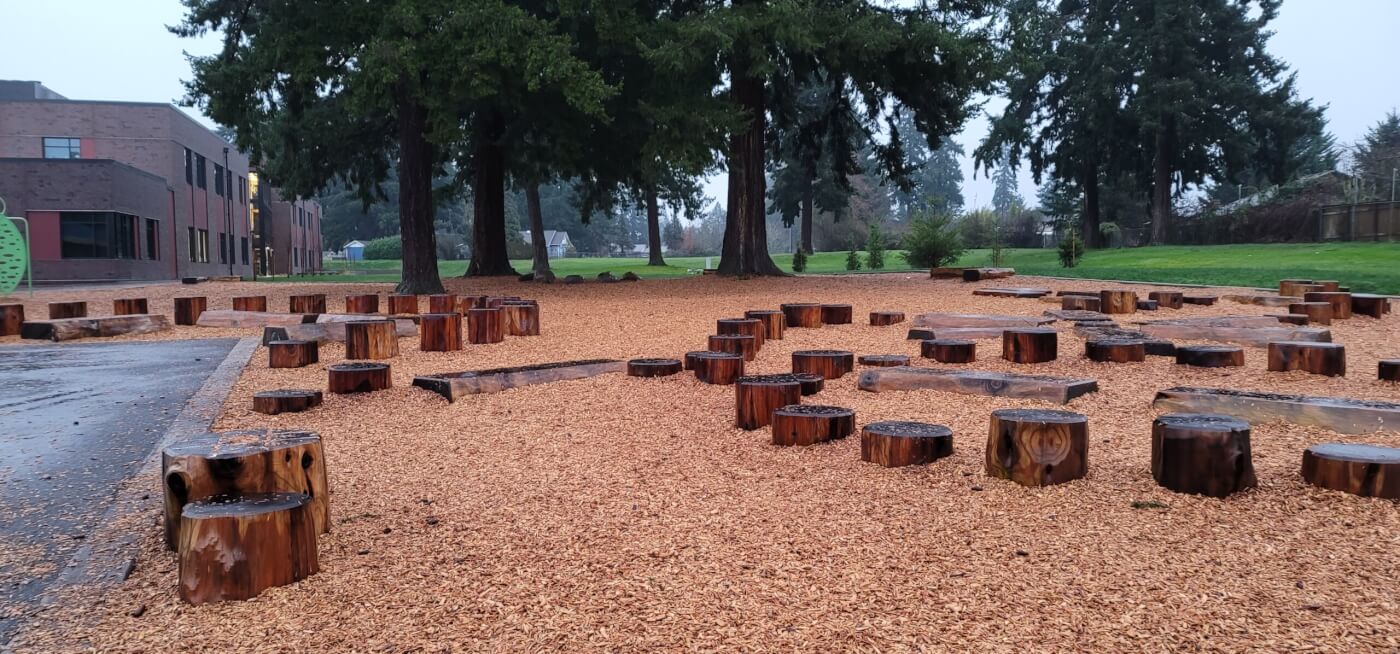
New in 2021, Marrion Elementary students get to enjoy a new landscape that invites children to play with natural elements and support teachers taking lessons outdoors.Marrion Elementary School in Vancouver, Washington. Photo by Jane Tesner Kleiner.
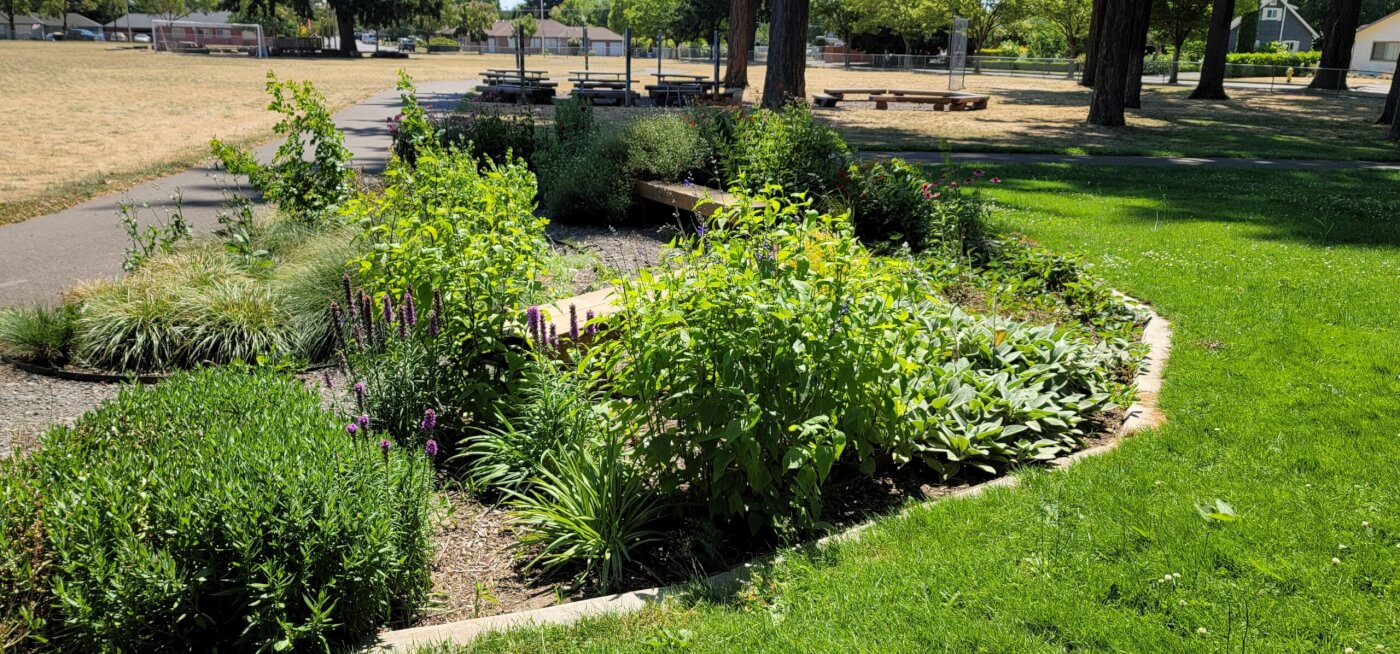
A butterfly, sensory and strawberry garden at Harney Elementary was designed to provide students and teachers contact with nature while creating a learning environment about local ecology. Learning gardens filled with vegetation such as native plants, bushes, trees and edible plants offer a wide range of learning opportunities. Harney Elementary School in Vancouver, Washington. Photo by Jane Tesner Kleiner.
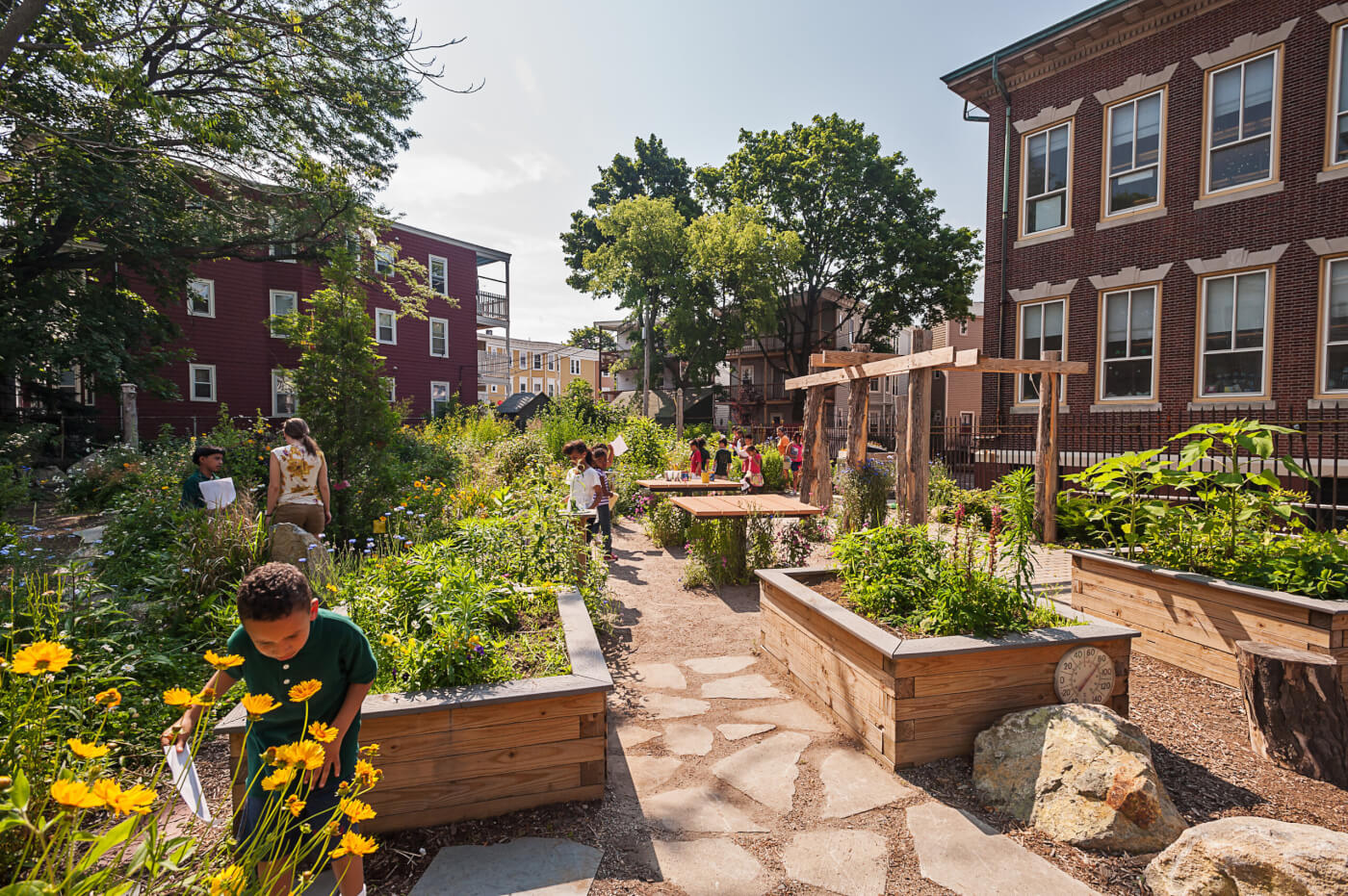
The Boston Schoolyard Initiative has transformed many of Boston public schoolyards from asphalt and weedy lots into dynamic and engaging spaces that provide many learning opportunities. A partnership between Green City Growers and Boston Public Schools offers a comprehensive cross-curricular vegetable garden enrichment program for students in K-12 classes.Boston Schoolyard Initiative, Winship Elementary School in Boston, Massachussets. Photo by Christian Phillips Photography.
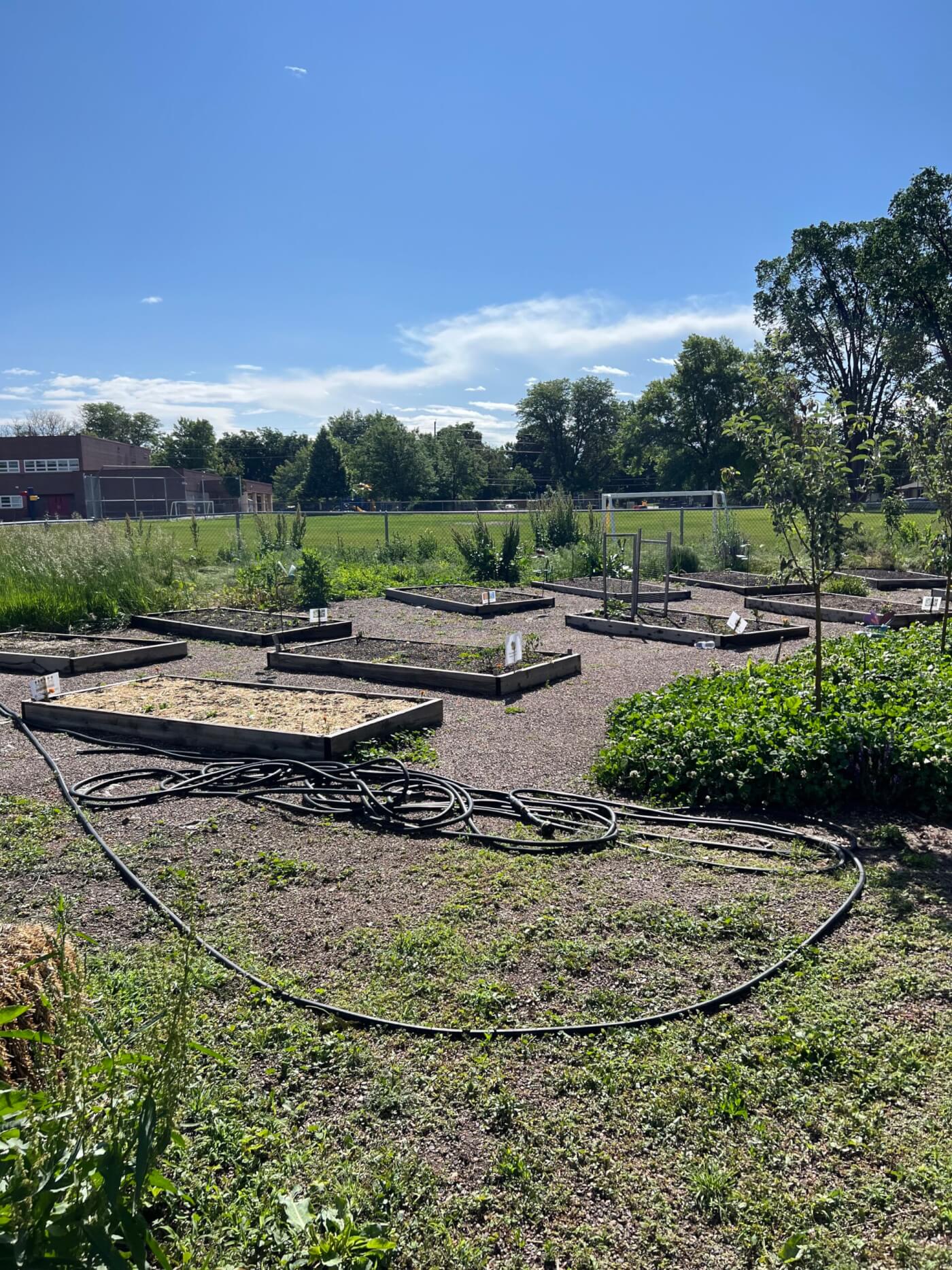
A partnership with Denver Urban Gardens has led to dozens of school-based gardens across metro Denver. DUG focuses on reducing barriers to fresh, healthy, and organic food.Ellis Elementary School in Denver, Colorado. Photo by Brenda Kessler.
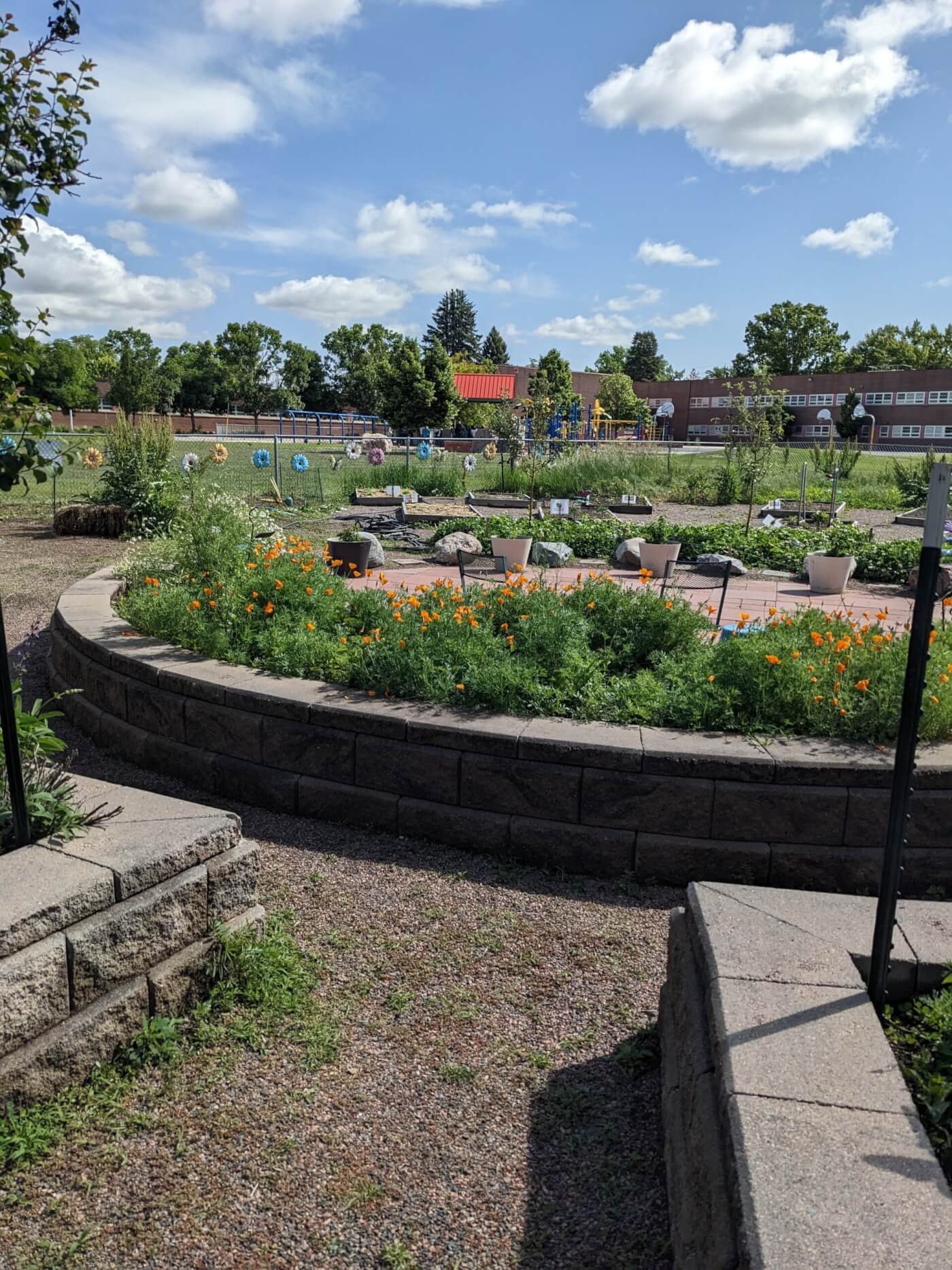
The raised garden beds at Ellis Elementary support students getting outside and learning about natural and environmental science through hands-on lessons.Ellis Elementary School in Denver, Colorado. Photo by Anne Mueller.
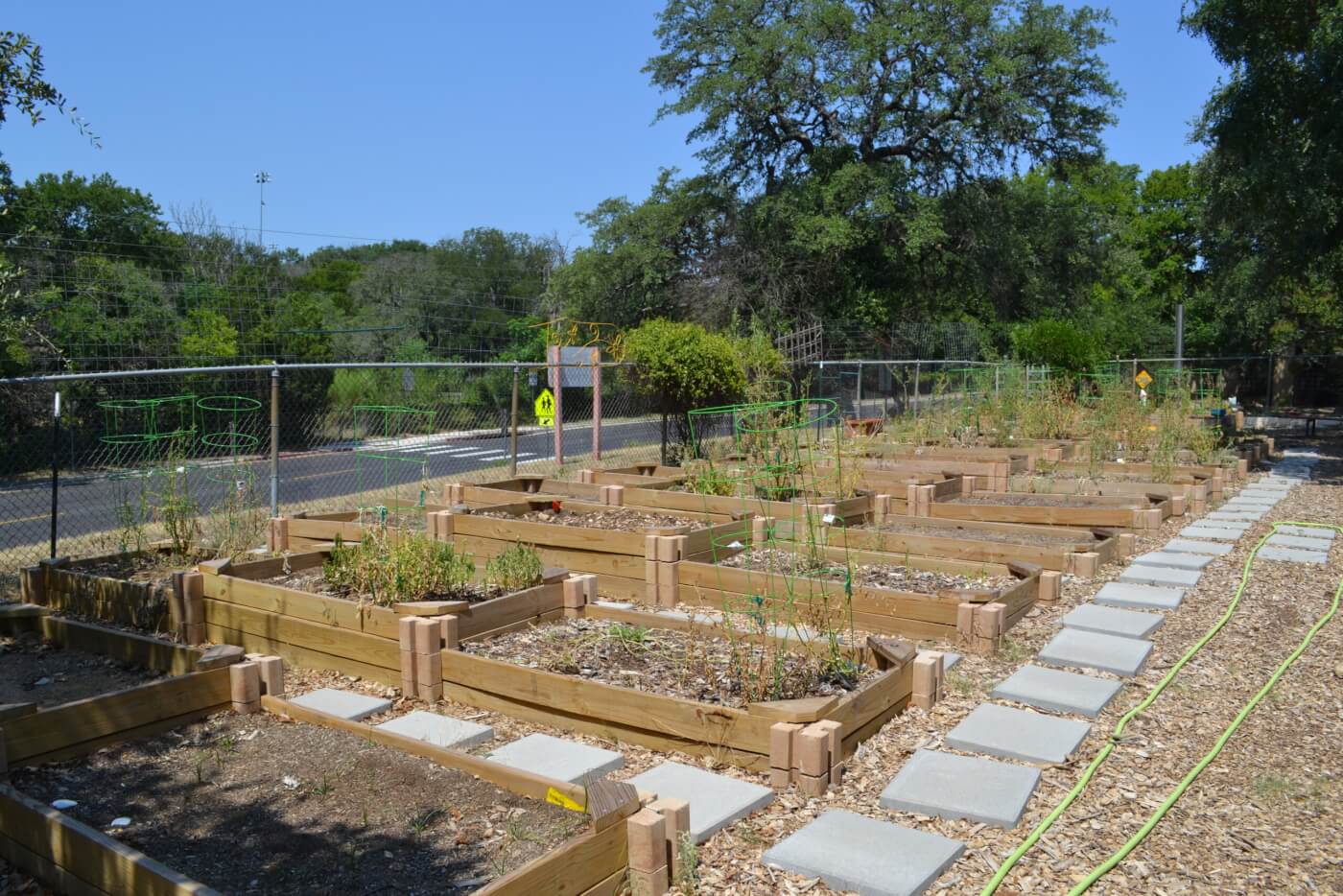
The garden beds at Hill Elementary School in Northwest Austin are a highlight of the school's outdoor learning program. In addition to classroom beds, the school makes some garden beds available for neighbors and community members, along with a sizable dirt-digging bed for all. Hill Elementary School in Austin, Texas. Photo by Austin Independent School District.
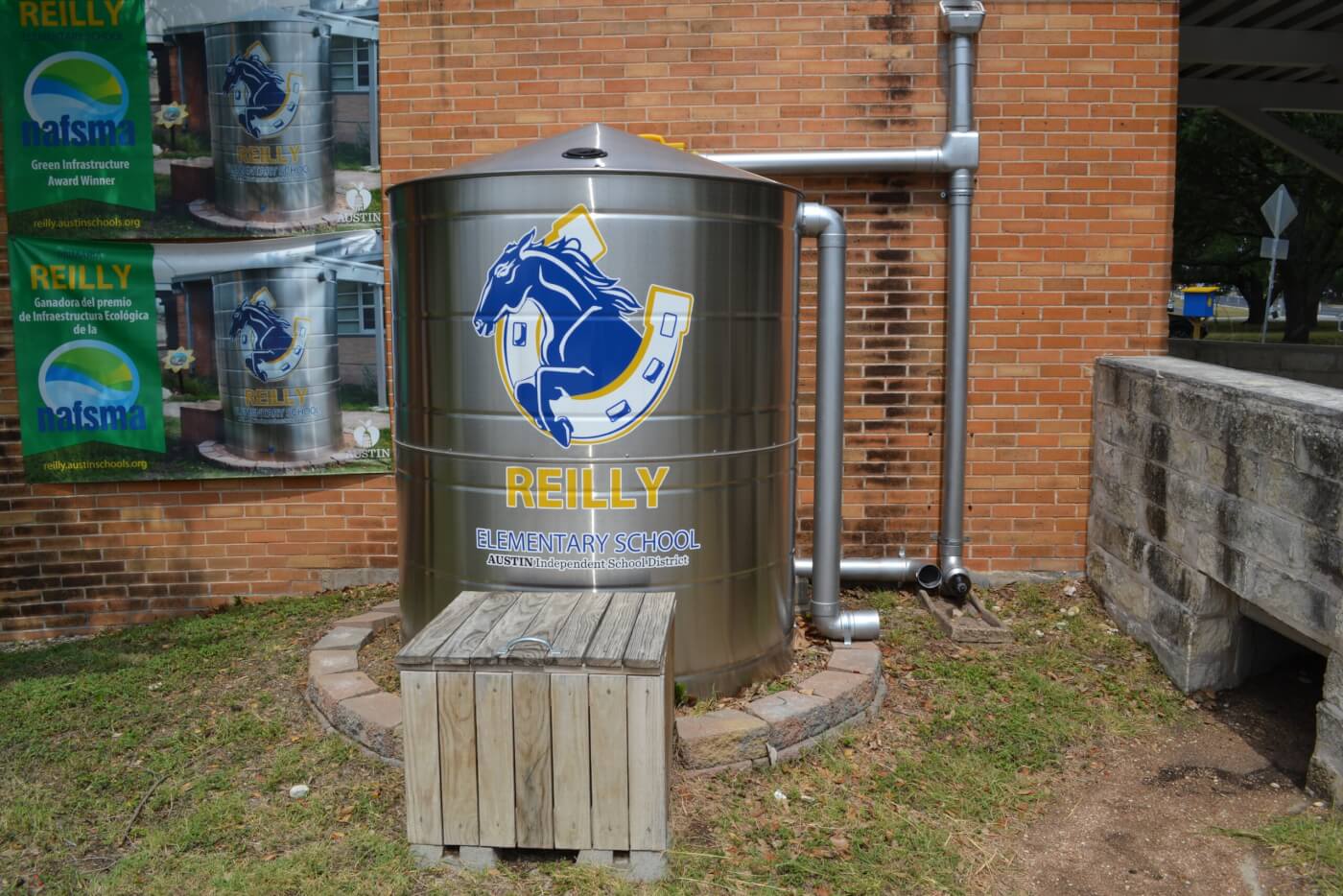
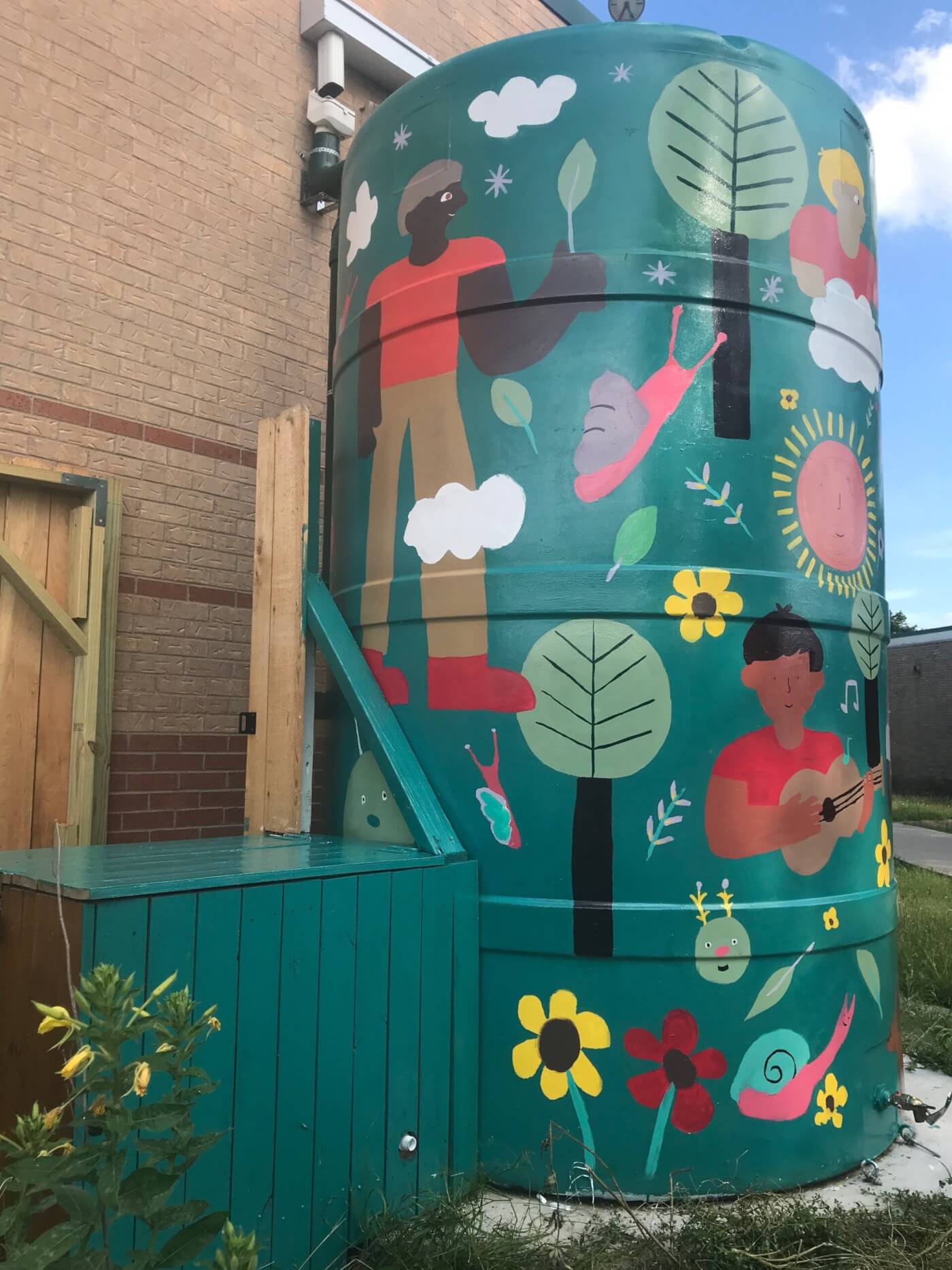
A stormwater project at Reilly Elementary won first place in the National Association of Flood & Stormwater Management Agencies (NAFSMA) Green Infrastructure Awards national competition. The 12 rain cisterns will help capture thousands of gallons of rain each year from the school's roofs and parking lots. Cisterns are great outdoor educational resources that may be used in classroom curricula to discuss the water cycle, environment, watersheds and effects of climate change.Reilly Elementary School in Austin, Texas. Photo by Austin Independent School District.
Completed in March 2018, Barrington Elementary became Austin’s first Green School Park. The “greening” of this school park added elements to enhance the native habitat, model sustainability and resourcefulness, and provide engaging features for community-based cooperation and outdoor learning. The Austin Parks and Recreation Department (PARD) hosted a variety of canvassing, surveying and voting events in an effort to attain insight on the features that park users would like to see. Barrington Elementary School in Austin, Texas. Photo by Austin Independent School District.
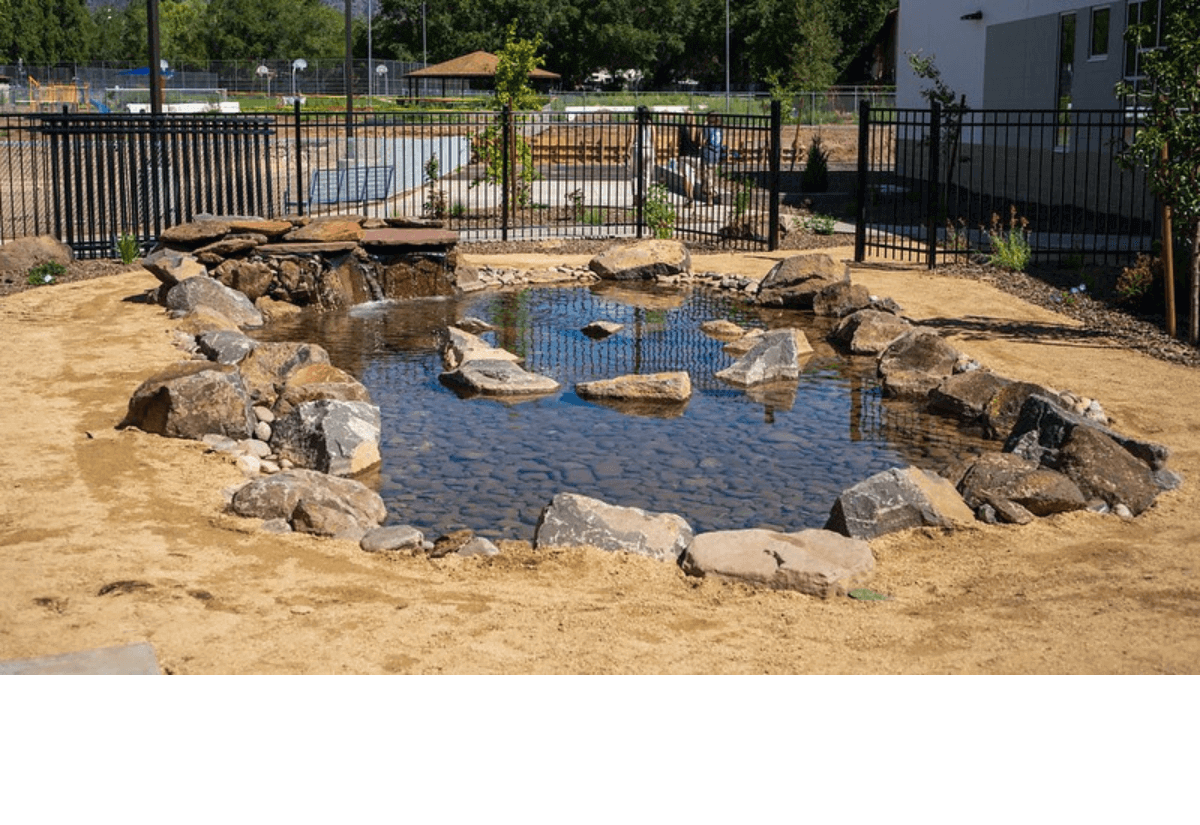
An element of Killip Elementary’s green schoolyard is aimed at water retention support.Killip Elementary School in Flagstaff, Arizona. Photo by Flagstaff Unified School District.
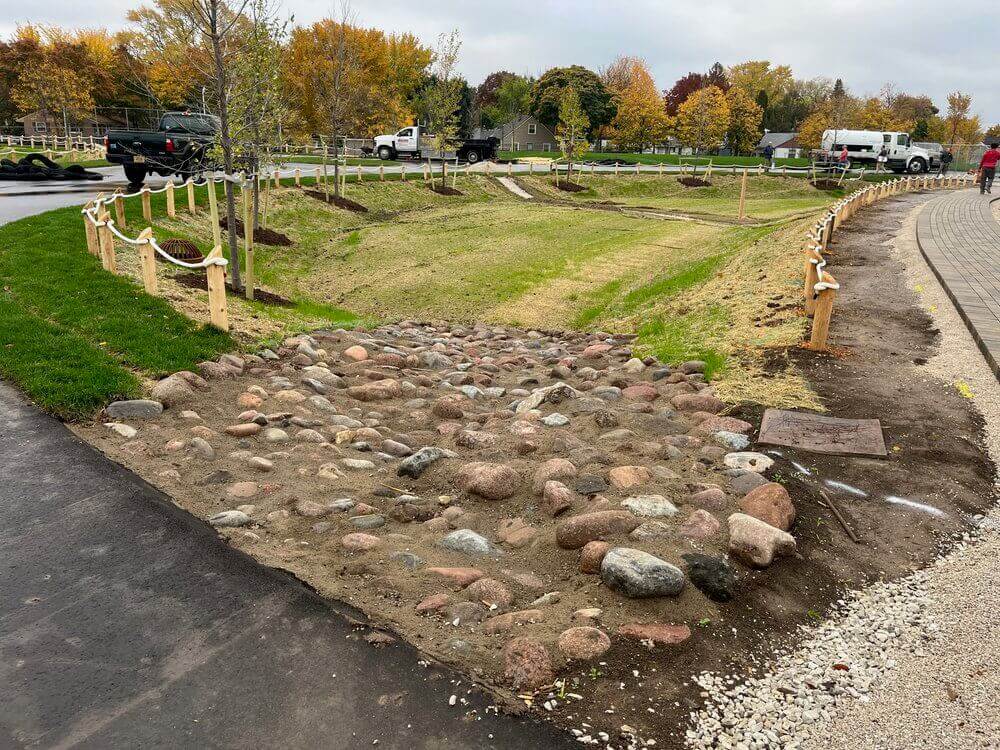
This green schoolyard incorporates a bioswale, a landscape depression designed to capture and filter stormwater runoffMilwaukee, Wisconsin. Photo by Reflo
Across the country, communities are grappling with the growing impacts of climate change, including flooding, air pollution, wildfires and extreme weather events. In response, many municipalities are taking action to reduce greenhouse gas emissions, build resilience and deliver co-benefits that improve air quality, expand green spaces and create stronger connections to nature. At the same time, leaders recognize that expanding access to nature, especially for children and families, can enhance mental and physical health, foster stronger community bonds and support long-term sustainability.
Climate resilience is the ability for built, economic, natural and social environments and communities to withstand and bounce forward from climate impacts. Green infrastructure and nature-based solutions that increase tree canopy, capture stormwater and cool urban heat islands have emerged as cost-effective and scalable strategies to advance these goals.
This Climate Resilience-Nature Connections Toolkit demonstrates how cities can pursue both goals of increasing climate resilience and fostering deeper connections to nature, simultaneously. Four proven strategies in this toolkit, Nature in Early Childhood, Green Schoolyards, Nature-Smart Libraries and Nature Exploration Areas, when combined with climate goals, create healthier, more resilient communities where children thrive and ecosystems are protected.
Drawing on real-world examples, the toolkit highlights how cities are already integrating these strategies to address climate challenges and deliver broad community benefits. With this resource, your community can explore practical approaches, learn from peers and take meaningful steps toward a greener, healthier and more resilient future.
Young children and the sites where they spend time face increasing risks from extreme heat, flooding and other climate-related impacts. Green infrastructure and nature-based solutions (NbS) can protect young children and caregivers while creating healthier, more engaging spaces for learning and play. By integrating climate resilience goals with increased access to nature, communities can protect young children, strengthen ecosystems and build resilience, while turning outdoor spaces into powerful learning environments.
The information presented below complements the Nature Everywhere Communities Nature in Early Childhood Toolkit. The Nature in Early Childhood toolkit explores ways to integrate nature connections into early childhood. Reorienting policies, programs and infrastructure to encourage more young children to play and learn outside should occur in a context that reduces risks related to excessive heat, poor air quality, sun exposure and flooding. This section dives into how climate resilience goals can be achieved simultaneously in early childhood settings.
Green infrastructure offers a range of opportunities for integrating climate resilience strategies with early childhood initiatives. Redesigned play and learning spaces can incorporate trees, native vegetation, rain gardens, permeable paving and shade structures to cool hot surfaces, improve air quality, manage stormwater and support biodiversity. Together, these strategies ensure that climate action and early learning reinforce one another, building both climate-smart communities and strong foundations for early childhood connections with nature.
Key strategies regarding children’s play and learning spaces that demonstrate this overlap include:
- Embedding resilience in infrastructure: Shade structures (such as pergolas, pavilions and sails) and native trees cool play areas, reduce heat exposure and extend outdoor playtime. In the City of Austin, shaded playgrounds were up to 10°F cooler than uncovered areas. Reflective pavements can also help. These features not only mitigate heat, flooding and fire risks but also create interactive and exploratory spaces for children.
- Supporting safe and sustainable landscapes: Native, drought-tolerant vegetation conserves water, lowers maintenance costs and supports biodiversity. Vegetated areas reduce heat islands, improve air quality, manage stormwater and provide playful, nature-rich learning spaces.
- Managing stormwater through green infrastructure: Rain gardens, bioswales and permeable paving help manage flooding while serving as hands-on learning areas that connect children directly to natural systems.
The overlap between climate resilience and early childhood extends beyond infrastructure. Policies, including licensing and Quality Rating and Improvement System (QRIS), can embed resilience benefits into standards for nature access and resilience planning itself should explicitly account for the needs of young children. Together, these strategies ensure that communities meet their climate action plans while also promoting early childhood development.
- Embedding resilience in early childhood policy: Encourage licensing and QRIS systems to recognize the dual benefits of nature access and climate resilience features, while ensuring that resilience plans explicitly account for the needs of young children.
- Setting standards for shade and safe outdoor play: Many cities establish requirements for shade in playgrounds, schoolyards and childcare sites. Heat action plans guide outdoor schedules around cooler times of day, shaded areas and hydration to keep children safe. For example, in the City of Boston, heat action plans provide guidance for scheduling outdoor learning activities during cooler times, in shaded areas with frequent hydration.
- Leveraging city and county climate action plans: Most cities have Climate Action Plans that prioritize investment in nature-based solutions, green infrastructure and resilient childcare facilities. This can include mixed-use childcare centers near transit, or capital funds for solar, landscaping, stormwater systems and community-led initiatives.
- A promising example is San Mateo County’s Early Childhood Climate Action Plan, which is slated to fund major upgrades and education campaigns.
- Utilizing community programs to enhance resilience: Cities can design initiatives that integrate early childhood goals with climate.
Families and children can and should, engage with early learning environments as opportunities for hands-on learning and meaningful connection. At this stage of development, the goal is not to teach abstract ideas about climate resilience or environmental responsibility, but to nurture joyful, hands-on experiences in nature that lay the foundation for care and curiosity later in life. When children regularly engage with nature, touching soil, observing plants and insects, or watching rain collect in a garden, they develop emotional bonds that evolve into pro-environmental attitudes as they grow.
- Integrating nature into daily learning: Outdoor features such as rain gardens, bioswales and vegetable gardens provide sensory and exploratory experiences that help children understand the rhythms of the natural world. These spaces encourage observation, play and discovery —essential first steps toward environmental awareness —while also cooling play areas and enriching daily routines.
- Supporting educators as guides, not instructors: Professional learning for early childhood educators should focus on fostering children’s curiosity and comfort outdoors, rather than directly emphasizing climate or resilience concepts. Training can include how to create open-ended nature play opportunities, model gentle curiosity,and respond to children’s questions in age-appropriate ways. Emergency preparedness and safety training remain important, but the emphasis in early learning should be on nurturing calm, curiosity and confidence in nature.
- Engaging families and communities through care and joy: Families and community members can reinforce this connection by participating in planting days, caring for gardens and engaging in outdoor exploration alongside children. These experiences strengthen family bonds, create shared memories and model caring behaviors toward nature, without placing the burden of environmental responsibility too early. Over time, such engagement helps build community pride and sustained support for early learning environments as shared, living spaces.
 Climate Resilience and Nature in Early Childhood Fact Sheet
Climate change acts as a barrier to reaching early childhood nature connection goals as children are considered a high-risk population when exposed to climate events such as extreme heat, air pollution and flooding. This resource helps align how to proceed with climate resilience and early childhood strategies.
Read More- Nature in Early Childhood Toolkit, Nature Everywhere Communities, a partnership of the Children & Nature Network, National League of Cities and KABOOM!)
- Nature Learning Initiative
School districts are often the second-largest property owners in a city, yet most schoolyards are covered in pavement or grass monocultures. Paved surfaces worsen stormwater runoff, intensify extreme heat and limit the time children can safely spend outdoors. Transforming these spaces is both an urgent climate resilience strategy and a powerful opportunity to connect students with the benefits of nature.
Green schoolyards are a proven solution. By converting asphalt and monoculture play areas into nature-rich spaces, designed with community input, they simultaneously address climate risks and expand children’s daily access to nature. Unlike traditional schoolyards with only grass and trees, green schoolyards incorporate diverse plantings, landforms and green infrastructure to maximize benefits for both students and communities.
To embed climate resilience and expand access to nature at scale, communities should adopt green schoolyards as a core local strategy. Their potential to transform school grounds into safe, equitable and climate-smart spaces makes them one of the most impactful investments districts can make. Explore the “Let’s Get Started!” Green Schoolyard Toolkit to learn more.
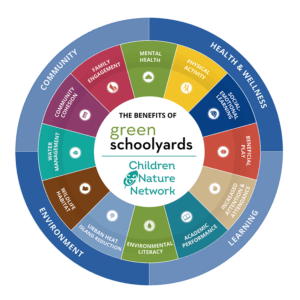
- Benefits of Green Schoolyards infographic
Green schoolyards offer numerous proven benefits for children, including enhanced academic achievement and improved health and wellness. As multifunctional spaces, green schoolyards:
- Protect children from climate-related risks, including extreme heat, flooding and poor air quality
- Reduce urban heat islands and manage stormwater through features like trees, rain gardens and permeable paving
- Strengthen biodiversity and create habitats for pollinators and wildlife
- Improve community health, wellness and environmental literacy
- Support academic success, physical health and social-emotional development
- Provide vibrant outdoor spaces for both students and the surrounding neighborhoods
Unlike conventional schoolyards dominated by asphalt and turf, green schoolyards are intentionally designed to incorporate green infrastructure and nature-based solutions, making them both climate-resilient and child-centered. These features transform school grounds from heat-trapping, flood-prone spaces into dynamic landscapes that protect children, support ecosystems and engage communities. By combining built and natural elements, green schoolyards reduce environmental risks while creating opportunities for learning, play and connection to nature.
Examples of green infrastructure and nature-based solutions in green schoolyards include:
- Built and natural shade: pergolas, pavilions, sails and shade trees that cool outdoor play areas
- Vegetation native bushes, shrubs and tall grasses that improve biodiversity, support infiltration and reduce flooding
- Fire-safe landscaping and the landscape principles of defensible space: buffer zones and resilient plantings that help slow the spread of wildfire – particularly important at the urban-wildland interface
- Green stormwater systems: rain gardens, bioswales, permeable pavements, tree plantings and native gardens that absorb and filter stormwater
- Community-based models, such as Space to Grow in Chicago, where redesigned schoolyards capture over 192,000 gallons of stormwater per rain event, that prioritize low-income communities
Developing and sustaining green schoolyards often requires creative financing strategies and strategic alignment to city-wide policies and plans. Projects are rarely funded through school district general or operating budgets. Instead, many communities have advanced green schoolyard initiatives by leveraging partnerships with agencies responsible for stormwater management, aligning shared goals around climate resilience and infrastructure. Others have incorporated green schoolyards as part of city-wide climate resilience plans or district-wide health and wellness plans. Other funding pathways include capital improvement programs, grants and community development resources.
Communities can align green schoolyard initiatives with local climate and sustainability goals. They can also learn from existing models, such as:
- The City of Austin’s Outdoor Bill of Rights is paired with Austin’s Climate Equity Plan.
- The Atlanta Community School Parks initiative delivers outdoor equity across the city, working to increase green space, replace asphalt with sustainable and more resilient surfacing alternatives, and expand nature and play access to the community through a formalized joint use agreement between the city and school district.
- The Portland Clean Energy Fund supports regenerative agriculture and green infrastructure through depaving and agriculture projects. Forty-four of the projects in Portland, Oregon, were completed on school grounds.
- Milwaukee’s Green Infrastructure Plan provides dedicated funding for schools.
Long-term success of green schoolyards depends on more than design and construction; it requires stewardship, ownership and ongoing neighborhood support. When students, families and community members are directly engaged, green schoolyards become living spaces that foster pride, build environmental literacy and sustain climate resilience over time. Engagement ensures that green schoolyards are not only places for play and learning, but also anchors for community resilience and collective understanding.
Ways to build stewardship and ownership include:
- Hands-on learning and co-design: Incorporate climate science, stormwater management and heat resilience into school curricula and invite students to co-create schoolyard designs.
- Place-based education: Use on-site features like rain gardens, permeable pavements and shade trees as outdoor classrooms for climate and environmental education.
- Food and health connections: Integrate vegetable gardens, fruit-bearing trees and rain barrels into lessons on nutrition, food systems and resource conservation.
- Biodiversity and ecosystems: Teach students and families about local plants, pollinators and wildlife, while reinforcing the role of native species in resilience to heat and wildfires.
- Community participation: Involve families and neighbors in planting days, maintenance and programming to strengthen ongoing neighborhood investment in the space.
 Climate Resilience in Green Schoolyards
Many communities are exploring green schoolyards as a strategy to increase educational and health equity as well as transform spaces into climate resilient, enriching outdoor areas for children and community. This resource explores how green schoolyards can address local climate goals.
Read More- Green Schoolyards for Healthy Communities, Children & Nature Network
- Green Schoolyard Design Feature Gallery, Children & Nature Network
- Green Schoolyards Advocacy Toolkit, Children & Nature Network
- Green Schoolyards America
- Smart Surfaces Policy Tracker, Smart Surfaces Coalition
- How Green Schoolyards Create Economic Value, by Rob Grunewal
Nature-Smart Libraries offer communities a unique opportunity to enhance climate resilience while connecting children to the outdoors in neighborhoods, thereby achieving multiple goals. With most people living within two miles of a local library, these community hubs can provide safe, engaging nature experiences through outdoor spaces, lending programs, curated collections and interactive programming.
Nature-Smart Libraries can:
- Serve as part of a community’s resiliency plans to protect children from extreme heat, flooding and poor air quality
- Serve as resilience hubs during climate emergencies by offering cooling, shelter and access to resources
- Foster stewardship, conservation and climate literacy within the community
The guidance below outlines strategies for integrating climate resilience into Nature-Smart Libraries. For more detailed guidance on developing a comprehensive Nature-Smart Library strategy, refer to the Nature Everywhere Communities Nature-Smart Library Toolkit.
Transforming the outdoor spaces and facilities of libraries can simultaneously advance environmental education, foster children’s connection to nature and strengthen climate resilience. Nature-smart upgrades present opportunities to support biodiversity, mitigate urban heat, manage stormwater and enhance the library’s role as a safe and resilient community hub.
These tactics show how libraries can be centers of learning, community gathering and climate-smart design all in one.
- Pollinator and educational gardens: Promote literacy and environmental learning while supporting local ecosystems
- Sun Ray Library (Saint Paul, MN) installed a pollinator prairie and outdoor reading garden.
- Outdoor story areas and mini-nature trails: Create pollinator gardens, outdoor reading areas and mini-nature trails to connect children with nature, encouraging curiosity, exploration and broader community engagement in conservation
- Natural and built shade structures: Provide shade through trees, solar arbors, pergolas and pavilions to reduce heat exposure
- Central Austin Public Library uses a solar panel arbor to shade a rooftop native plant garden.
- Permeable and cool pavements: Reduce heat and support sustainable stormwater management while making outdoor library spaces more accessible to children and families for outdoor play
Library buildings themselves can also contribute to resilience by incorporating energy conservation methods, such as solar photovoltaic panels, and implementing energy resilience measures. This allows libraries to reduce energy costs and operate off-grid during emergencies. Libraries can also incorporate green and cool roofs, which mitigate urban heat, improve insulation and manage stormwater. The New Canaan, Connecticut Library combines solar PV, light-colored roofing and a shallow sedum green roof.
Resilience features of library networks deserve attention in city or county climate action plans. They can also serve as resilience hubs during climate emergencies such as heat waves, power outages and storms. Creating and aligning Nature-Smart Libraries with community-wide climate action initiatives, particularly those focused on children and nature, can support system-wide approaches to climate resilience and emergency preparedness. Libraries can lead by example through sustainable design, standardized practices across networks and functioning as hubs during extreme weather events. This approach positions Nature-Smart Libraries as both educational resources and essential infrastructure for climate resilience and community safety.
Examples:
- Austin, TX: The City of Austin Public Library integrates the Austin Climate Equity Plan, emphasizing sustainable design and construction standards.
- King County, WA: The King County Climate Action Plan sets short- and long-term goals for library networks, covering sustainable building design, water and energy use and community resilience.
- Grand County, UT: Libraries serve as long-term shelters during emergencies through the Emergency Operations Plan, provide activities for children and disseminate family-friendly information about the state’s disaster program, Be Ready Utah.
- Chicago, IL: During heat emergency events, libraries provide a cool shelter, while the Chicago Climate Action Plan ensures that all new city buildings, including seven public libraries, are built to LEED Silver standards.
Integrating climate resilience into library curricula and programs allows Nature-Smart Libraries to strengthen literacy, environmental education and stewardship from an early age. Libraries can provide hands-on, engaging opportunities for children and the community while highlighting the important role library staff play as environmental educators and advocates for just energy transitions. Across the country, libraries are leveraging programming, community engagement and green infrastructure to educate, inspire and build resilience. These activities help center the library as an essential resource within the community for knowledge and learning about climate resilience issues, particularly those affecting the local community.
Examples:
- Brooklyn Public Library (Greenpoint, NY): Renovated branch serves as the Greenpoint Environmental Education Center, combining green infrastructure with community environmental education programs
- Boston Public Library (MA): Offers public guides on green workforce development and climate resilience education
- American Library Association: Provides a comprehensive guide for climate-focused programming, including book clubs, community dialogues and mindfulness initiatives that promote environmental stewardship
- Workshops nationwide: Libraries host programs on climate resilience, green workforce skills and community engagement to empower participants and strengthen local climate action.
Nature-Smart Libraries Fact Sheet
Nature-smart libraries are uniquely positioned to act as a hub for local climate resilience efforts. This resource explores ways that libraries can serve to address local climate resilience goals.
Read More- Nature-Smart Libraries Toolkit, Children & Nature Network
- Sustainable Libraries Initiative, Resource Page
As cities grow and green spaces shrink, Nature Exploration Areas (NEAs) provide children and communities with nearby, equitable access to nature while offering opportunities to enhance climate resilience. NEAs transform public lands as small as a pocket park into interactive, sustainable places for play, learning and connection. They are designed spaces that encourage play, creativity and exploration in nature and are built with local, natural materials to foster physical activity and curiosity.
The information below has been adapted from KABOOM!’s Nature Exploration Areas Toolkit, a Nature Everywhere Communities initaitive resource. The sections outlined below explicitly pull climate resilience references and information from KABOOM!’s toolkit.
Nature exploration areas can expand access to greenspace in underserved communities and strengthen community stewardship and advance environmental justice. Since the intention of NEAs is to bring natural elements into play spaces, they provide a prime opportunity to also integrate green infrastructure and nature-based solutions for climate resilience. They have the potential to reduce urban heat islands by providing shade, trees and permeable natural surfaces. They can also improve stormwater management through rain gardens, bioswales and permeable pathways while also supporting biodiversity with native plants, pollinator habitats and natural ecosystems.
NEAs can play a critical role in addressing environmental justice issues by bringing high-quality green spaces to historically underserved communities. In many urban areas, low-income neighborhoods have significantly more limited access to parks and nature, contributing to disparities in physical health, mental well-being and overall quality of life. Involving local residents, especially those in low-income communities, in the design, development and maintenance of NEA projects helps to foster a sense of community pride, stewardship and long-term engagement.
As cities face increasing challenges from climate change, NEAs offer a unique and flexible solution for building community resilience. Thoughtfully designed NEAs integrate features that help mitigate climate-related risks such as extreme heat, poor air quality and stormwater runoff. Urban areas experience the heat island effect, where concrete and asphalt retain heat, leading to higher temperatures. NEAs counteract this by incorporating shade structures, tree canopies and permeable natural surfaces, which cool surrounding areas and provide refuge from extreme heat. NEAs often include permeable surfaces and rain gardens to help absorb and filter stormwater, reducing flooding and improving water quality. Finally, by incorporating native plants, pollinator gardens and natural materials, NEAs can support local ecosystems and improve air quality, tree cover and green spaces.
Plan and Implement with Climate in Mind
- Site selection should evaluate sun exposure, drainage, soil quality and existing vegetation.
- Projects should prioritize degraded or underused land that can be revitalized sustainably.
- Partnerships with environmental groups, funders and utilities can expand capacity and funding for climate-smart designs.
Use Sustainable Materials
- Locally sourced and recycled materials, such as salvaged wood, recycled stone and permeable surfaces, can minimize environmental impact.
- Safety and sensory play can be supported with mulch, natural fibers or engineered wood fiber.
- Repurposed industrial and urban forestry materials can create unique and durable play features.
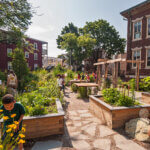
To an adult, tree rounds scattered around a schoolyard may seem a little boring. But through the eyes of a child, stumps can be magical.
Read More- Nature Exploration Area Toolkit, KABOOM!, in partnership with the Children & Nature Network, National League of Cities
Achieving climate resilience goals, whether through green schoolyards, early childhood nature connections, nature-smart libraries or nature exploration areas, depends on strong partnerships. Local governments, community organizations, educators and families each bring unique expertise and resources, including policy leadership and funding, trusted relationships, daily engagement with children and lived community experience. When these partners align around shared goals, understand community needs and coordinate resources, they can drive solutions that are both practical and transformative.
The resource listed below stems from over ten years of working with communities through Cities Connecting Children to Nature (CCCN) and Nature Everywhere Communities. They have proven to be critical steps in any process and can be utilized to align climate resiliency goals with children and nature connection strategies.
Understanding how climate resiliency strategies align with local priorities — and how they can advance city or county goals — helps partners determine the best ways to collaborate. Equally important is establishing a shared vision from the outset. When partners agree on common goals and outcomes, such as community well-being, public health, equitable access to nature and long-term sustainability, they create a foundation for stronger collaboration. Aligning on this vision is a critical first step in clarifying roles, maximizing resources and ensuring that climate resiliency strategies reduce risks from extreme heat and flooding, strengthen ecosystems and create healthier, safer spaces for children and families.
Creating a Vision for Equitable Access to Nature
This resource aims to support a visioning is a process through which community partners develop a vision statement that sets the course for the local children and nature initiative. Through public engagement, the community defines its purpose, core values, and ambitions for the future.
Read MoreOver the past decade, work with communities across the country has shown that collaboration is the foundation for progress. By working together, partners not only strengthen climate resilience but also advance a variety of outcomes, from healthier children and families to stronger ecosystems and more vibrant neighborhoods. This is why it is essential to engage stakeholders and garner support from various sectors and leadership across a community.
Nature Everywhere Communities Action Challenge Gathering Stakeholders
Engaging local stakeholders helps align new children and nature strategies with previous efforts and community goals.
Read More
Nature Everywhere Communities Action Challenge Pledge of Support, Resolutions & Proclamations
For communities working to incorporate nature-based solutions to children’s health and development, the support of local government officials or school leadership can catalyze coalition building and action.
Read More
Building a Successful Cross-Sector Team
What is a cross-sector team and why is it important for the success of Nature Everywhere Communities initiative?
Read MoreCommunity assessments are essential for identifying local assets, vulnerabilities and investment priorities related to climate resiliency. By mapping where risks such as extreme heat, flooding or poor air quality intersect with areas where children and families have limited access to nature, communities can better target interventions. Landscape scans further reveal shared goals, available resources and opportunities for collaboration across sectors, ensuring that strategies are not only responsive to local needs but also aligned with broader community priorities and policies. Tools such as equity mapping, while often focused on early childhood, can be applied more broadly to inform climate resilience planning, helping ensure that investments deliver the greatest benefits for children, families and communities most affected by climate impacts.
Nature Everywhere Community Action Challenge Landscape Scans
The early phase of Nature Everywhere Communities involves a planning phase to “map the landscape” of the local systems both literally and figuratively.
Read More
Creating a Vision for Equitable Access to Nature
Equity maps depict how nature appears in a city relative to key demographic, economic, and social data.
Read MoreDenver’s Parks and Recreation Department (DPR), in collaboration with partners, community members and other City departments, has been driving the creation of early childhood nature connection policies, initiatives and sites across the city. With significant portions of the city’s population living in areas of nature deficit and becoming more impacted by climate change, Denver embeds sustainability and climate resilience into their early childhood nature connection policies, partnerships and initiatives to ensure long-term ability for children and their community to learn, play and grow in nature.
Aligning City-Wide Policies
Created by DPR, Denver’s Game Plan for a Healthy City outlines a long-term strategic plan for the future growth and maintenance of its parks and recreation system. The plan included policies and guiding principles for establishing city-wide connections between children and nature. The plan’s goals include ensuring that every resident has access to park or open space within a ten-minute walk, as well as promoting access to nature for children. By increasing the presence of natural areas in or near neighborhoods, the city will be able to reduce its nature deficit, thereby providing the public with opportunities to access natural experiences. Strategies to achieve this include developing nature loops and walks, as well as incorporating nature play into new and renovated parks.
Permitting for Unique Landscapes
To implement these overarching goals for children and nature, DPR partnered with the Mile High Flood Protection District (MHFD) to establish Nature Play in the Built Environment Design Standards and Guidelines. By recognizing the opportunity to create nature play spaces in existing natural areas protected by easements that prevent other types of park development, the guidelines allow for future MHPF opportunities to revitalize and rehabilitate these natural areas. Design standards also include opportunities for sensory engagement and play, muscle development and cognitive development along with accessibility standards for all children. The guidelines established recommend play components, natural materials, surface materials, landscaping as well as emphasize the importance of nature landscapes. They also present maintenance guidance and permitting processes for the unique spaces, many of which are within the MHFP and require special permits.
Climate Resilient Design Features
DPS is utilizing green infrastructure across several parks in order to help create more climate-resilient spaces. The 39th Avenue Greenway, for example, is home to two nature play areas designed to serve as major stormwater conveyance infrastructure, helping to reduce flooding during extreme weather events. Located in one of Denver’s most polluted zip codes, Heron Pond is currently being developed as a new regional park and playground that will provide ecological learning and access to nature to a historically underserved community. The site will mitigate contamination in soil, provide water quality treatment, restore and create native habitats and expand existing pollinator gardens.
Nestled next to Lake Michigan, the City of Milwaukee faces a significant risk of damaging floods and storm surges, which are increasing in frequency and intensity due to stormwater runoff. When faced with heavy rain events, the combined sewer system becomes overwhelmed with untreated stormwater and sewage, resulting in spills into the city’s waterways. The city also has a history of public schoolyards lacking green space, particularly in historically disadvantaged communities, which exposes children and community members to urban heat islands during hot weather. To alleviate this problem, the city and community look to green schoolyards as a pathway to improve climate resilience and the schoolgrounds where children learn, play and grow through strong partnerships, funding mechanisms and environmental curriculum for over 12,000 students and 20,000 community members.
Creating Partnerships to Unlock Green Schoolyards
Reflo, an environmental nonprofit based in the city, has been a key partner in transforming schoolgrounds to make them more resilient since 2015. The nonprofit partnered with the Milwaukee Metropolitan Sewerage District, Milwaukee Public Schools, the City of Milwaukee and others to implement nature-based solutions and green infrastructure in schools across the city, replacing hot, impermeable surfaces such as asphalt that contribute to urban heat islands and poor stormwater management. By planting trees and pollinator gardens, green schoolyards can now capture and redirect stormwater, thereby increasing resilience during extreme weather events. As of 2025, the Green and Healthy Schools Program has helped to complete 36 schoolyard re-greening projects, with more currently in development.
Financing for Resilient Green Schoolyards
Funding comes from a mix of public and private sources, including federal and state-level grants, the Fund for Lake Michigan and the Milwaukee Public Schools Foundation. Financing from the city is legitimized through the Green Infrastructure Plan, which has the Milwaukee Metropolitan Sewerage District distributing at least $600,000 annually to the school district to support projects and fund a Sustainability Specialist position.
Co-Designing Spaces to Grow and Thrive with the Environment
The green schoolyards don’t just act as spaces for children to play at recess and after school hours. Led by Reflo and the University of Wisconsin-Wilwaukee, outdoor classrooms and curricular activities are co-designed with children and staff through workshops, exposing them to learning opportunities around design, environmental management and architecture. Now children can sit under the shade to cool off while observing and learning about the nature around them. Older youth and teens are taught about agriculture and sustainable forestry, as well as pathways to unlock careers in these fields.
Climate-Resilient Design in Austin, TX
Through its Nature-Smart Library initiative, the Austin Public Library (APL) promotes nature exploration and climate resilience to better address nature access disparities and meet sustainability goals. APL has embedded environmental education, outdoor learning and greenspaces to help build environmental awareness through programs such as StoryWalks®, lending programs for nature kits and walking trails with native plants. The Central Library, specifically, is a feat of sustainable design. The LEED Platinum-certified building, situated on a redeveloped brownfield, features a rooftop garden filled with native plants, where children can read and learn while shaded by a native tree and solar photovoltaic panels. Not only does the building run on 100% renewable energy, but the site also contains 33%vegetated open space and has reduced impervious cover by 36%. This reimaged outdoor space invites the community to connect with nature, while uplifting the environmental benefits abundant around the library.
Pollinator Gardens in Saint Paul, MN
Since 2013, the Sun Ray Library has utilized a pollinator prairie garden and outdoor reading garden to help promote biodiversity and environmental education. The garden, rich with native prairie flora, helps to reintroduce local plants to the site and provide children the opportunity to explore and learn about how they support the ecosystem. A collection of environmental activities, such as nature backpacks, has also been utilized to promote literacy, providing hands-on learning to children who do not typically have the opportunity to explore nature. These investments in resilience and children were supported through Explore Outdoors Saint Paul, a cross-agency commitment to promoting equitable natural access for children through programming, partnerships and policy.

In Flagstaff, green schoolyards sprout after climate-related disasters
Finding Nature News feature
Climate-related fires and floods are all too common these days for cities in the western United States. Unfortunately, this is precisely the story of Flagstaff, Arizona and for the...

In search of a greener schoolyard: As the planet heats up, green schoolyards offer a world of benefits
Finding Nature News feature
On a hot summer day, time seems to slow to a crawl, and our instinct is to head indoors, shelter in the air conditioning and drink something...

Designing Climate-Resilient Outdoor Spaces with Nature-Based Solutions
NLC CitiesSpeak story
Imagine a neighborhood where young children and caregivers can explore nature-rich environments with plenty of shade, trees and...

How Nature-Based Solutions and Green Infrastructure are Helping Cities Meet Their Climate Action Goals
NLC CitiesSpeak story
Advancing local climate action is essential not only to withstand unavoidable climate impacts, such as flooding and extreme heat, but also...
Nature Everywhere Communities Newsletter
Stay on top the news, resources and research for city and community leaders working to increase equitable access to nature.
SubscribeThese resources were developed in partnership with

Copyright © 2025 by National League of Cities Institute, Children & Nature Network and KABOOM! All rights reserved.
DONATE TODAY TO BECOME A MEMBER
Help us make sure that all children live, learn and grow with nature in their daily lives.