
Crossing invisible boundaries in the outdoors: A Q+A with Mason Branstrator
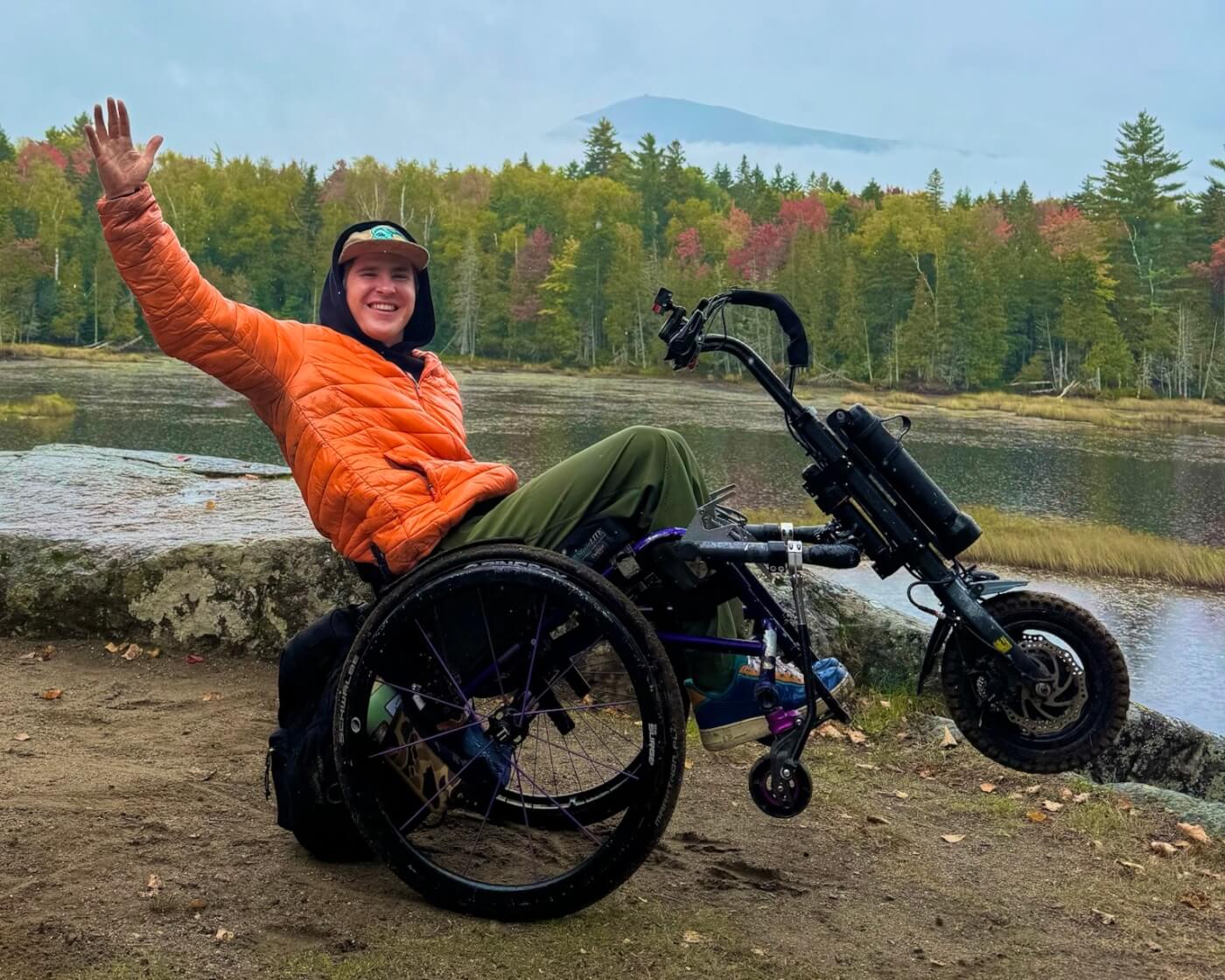
“Everything is less complicated when you’re in the woods,” reflects Mason Branstrator. “I think that’s what I’ve always liked about it. There’s a sense of peace.”
Mason Branstrator is a content creator, athlete and speaker. He’s also a T12 paraplegic. After a ski accident left Branstrator partially paralyzed at 17, he’s been rediscovering his relationship to movement — and the outdoors — and sharing his journey on social media.
Branstrator navigates nature with his wheelchair (and an adaptive mountain bike!) and while the logistics of getting outdoors have changed, the reason he does it remains the same: freedom, independence, smells, scenery and hard exertion — or simply a breath of fresh air.
We caught up with Branstrator to learn more about his journey and relationship to nature.
How did you spend time outside as a child — and how do you connect with nature in your daily life, today?
I grew up living on a lake, right in my backyard, so I’ve pretty much been outside as much as possible for my whole life. I grew up playing soccer, running track and field and getting involved in pretty much every outdoor recreation thing that I could.
Now, every morning, I go outside to get some sunlight in my eyes. I’ll just take in the sunrise and the lake and the breeze and the wind chimes and the colors. I think about the animals and birds and how they move — how everything’s just perfectly living in tandem, and none of the creatures are in a rush. When you recognize that this is where you came from, it takes off the pressure of trying to be this supercharged, perfect human being at every second of the day. That’s just not how we were programmed to be. We need rest and peace, and I think nature is a good reminder that that is an equally important way of life — to just be.
Could you tell me about your accident and how it changed your life?
I went out for an average day of downhill skiing, January 18, 2021. I decided to hit a jump on the first run of the day, and the last thought I had leading up to the accident was that I was going a little bit fast — and then pretty much everything went black. The next thing I knew, I woke up in the ICU, and they told me I was paralyzed. I was just 17, a junior in high school, sitting in the ICU thinking that I was having a nightmare. But then, as the days went on, it was like, “Okay, this is real. This is my new reality.”
Spinal cord injury comes with so many different complications. Every day, I learn something new about how my body functions now, how to adapt to the function that I do have, different treatments and finding the right doctors. I mean, it’s an ongoing battle.
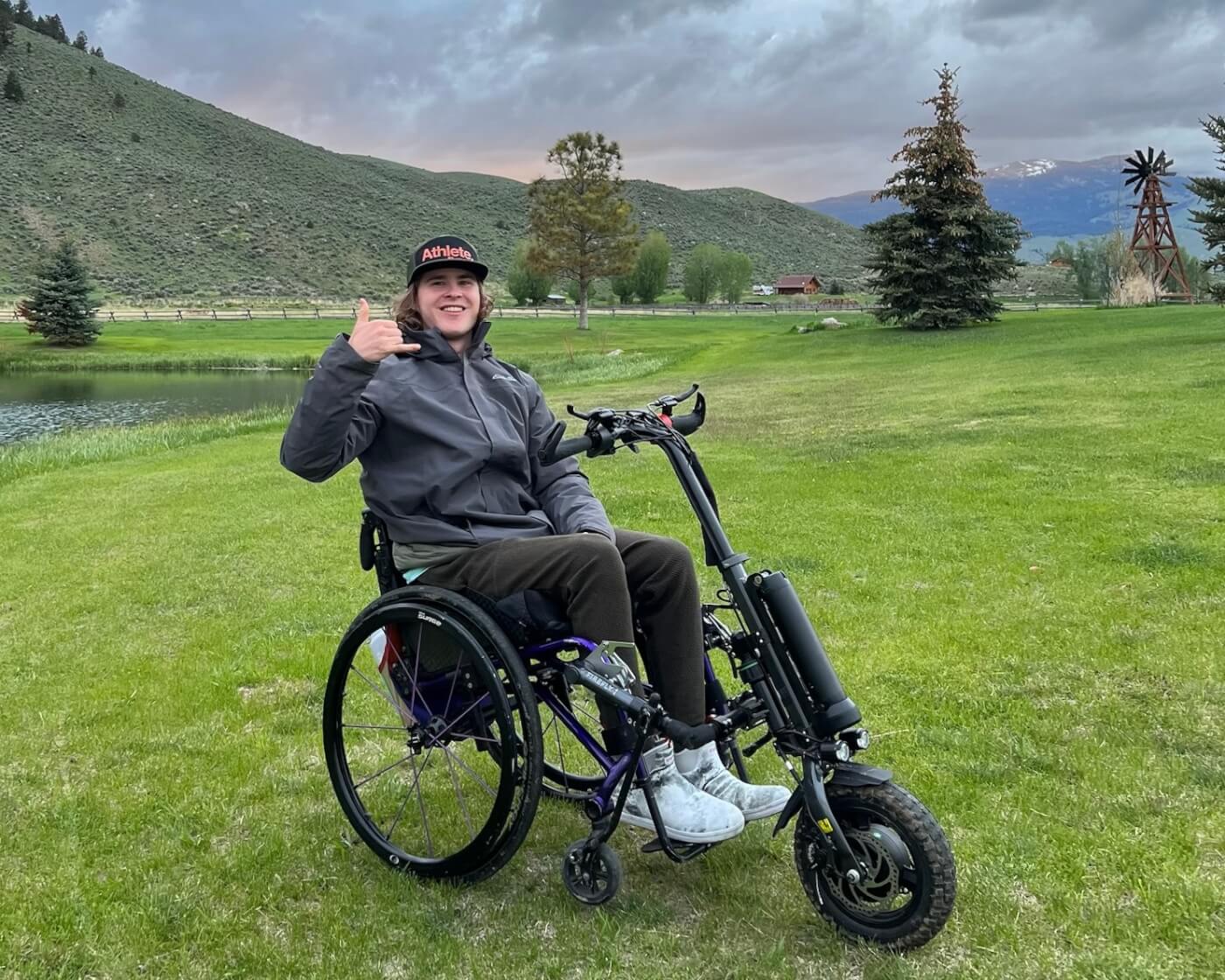
Mason’s electric wheelchair attachment “The Firefly 2.5” helps him access uneven terrain like gravel, grass and hills. He is able to reach places quickly and easily that he would have a much harder time exploring in his manual wheelchair alone.
What was the process of reconnecting with the outdoors and outdoor recreation like after your injury?
In the beginning, there were a whole bunch of people telling me I could get back to adaptive sports, and I was super against it. The last thing that I wanted to do was go and injure myself. I was really focused on my recovery and trying to walk again.
But after a year and a half, I thought, “All right, I’ll try to get back to some activities, because I kind of have the function in my legs that I’ll probably get back at this point. And I’m not going to be running outside like I used to.” So I got in touch with my local adaptive recreation program, Northland Adaptive Recreation, which operates in the Duluth and surrounding area — or I should say, they got in touch with me.
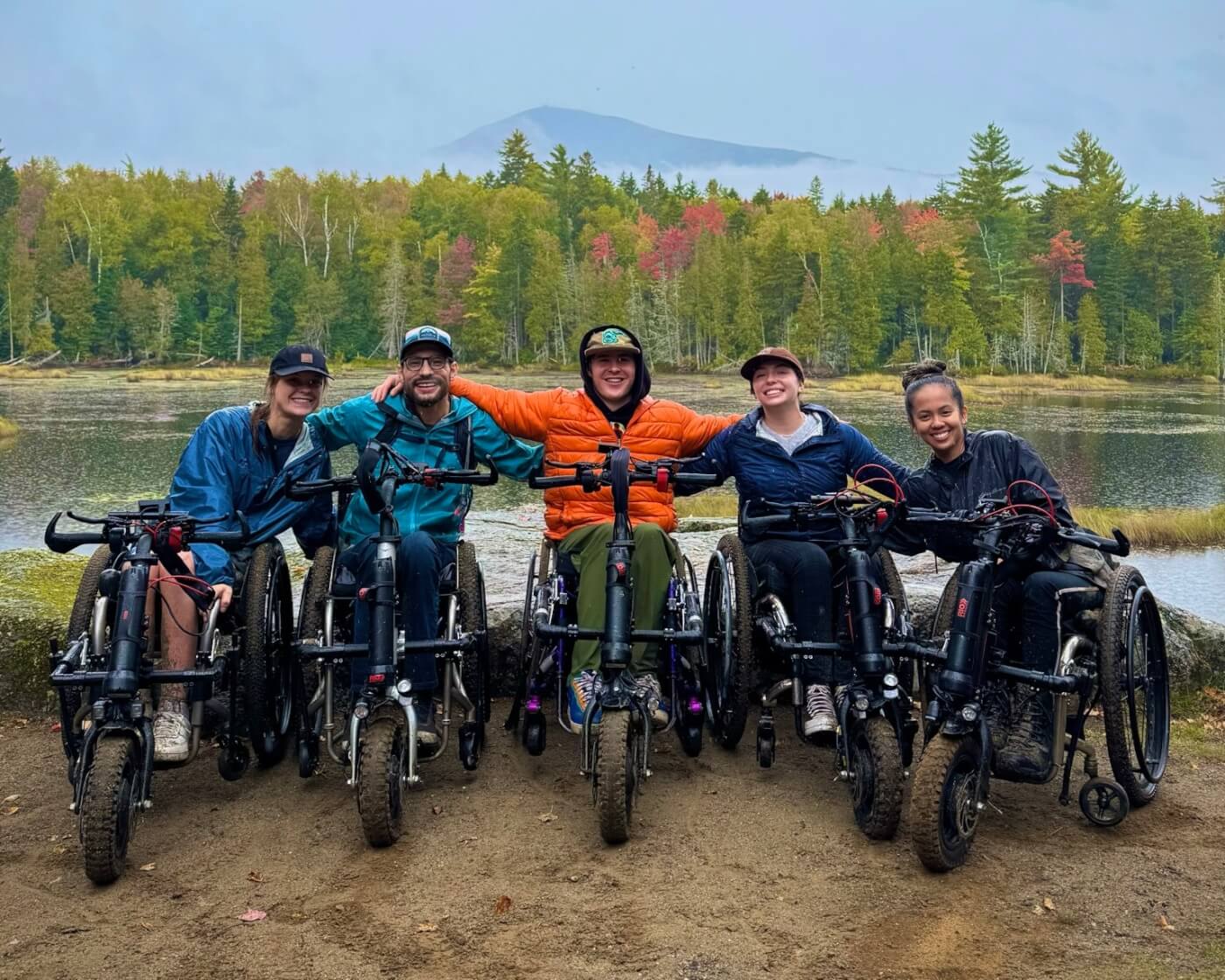
Mason with friends on an autumn hike at the Adaptive Outdoor Education Center (AOEC) in Maine.
I tried a lot of different things, and they all gave me more hope about being able to experience the outdoors despite my injury. I went on a couple different trips, I went mountain biking, I even went surfing. I took out the Action Trackchairs. They have them at a whole bunch of state parks in Minnesota. You can go on the website and see where they are. That was a pretty sweet experience — to have that accessibility.
Do any of those first moments back in the outdoors stand out to you?
Trying cross country skiing. Northland Adaptive set up a clinic, and my friends were there — there’s not too many of us who are paralyzed in Duluth, so we all know each other — and we were all trying it together. I just loved it. They had one lap on a frozen lake and I went around that lap as many times as I could.
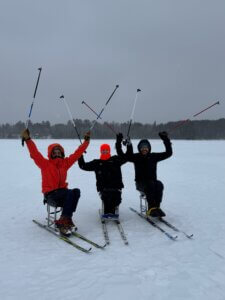
Mason cross country skiing with friends using sit skis at the North of North Resort, an adaptive resort in Ely, Minnesota.
Being able to exercise outdoors again was everything to me, at that time, because I felt pretty limited in terms of the ways I could do exercise. Before, I would run the gravel roads around my house, I would go hiking in the woods. What I really missed about being able to walk and run outside was the feeling that came along with it — part of that is that hard exertion, part of that is the smell and the scenery. But those things don’t change, even when you’re exercising a little bit differently. So, trying cross country skiing and being on the snow, pushing myself along without worrying about my wheelchair getting stuck, was really freeing.
How has your overall relationship to the outdoors changed since your injury?
Certainly in the way that I’m able to interact with it. Living in a wheelchair, there are invisible boundaries that you can see but other people don’t realize. So, that can be hard at times. When you lose your mobility, spontaneity is one of the biggest things that’s taken from you, and you have to plan out everything so that you know you’re able to use the bathroom at every time in the day — so that you don’t injure your body, so that your body is comfortable, so that you’re not in pain. It’s all these different things. Planning it all out and making the time to do it is really important, because otherwise it doesn’t happen.
The outdoors has also impacted me internally in a way that helps me not feel limited. I can still see the sights, I can still smell the smells, and I feel free. The more accessible different areas are, the more I’m able to be a part of nature and have those same experiences that I did before the injury — and the more others are able to have the same experiences.
A lot of your social media posts advocate for getting outside or demonstrate how you participate in outdoor recreation. Why is it important to share that time outside with your audience?
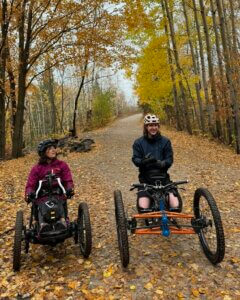
Wider trails and adaptive equipment — like adaptive mountain bikes and handcycles — make the outdoors more accessible to all. Here, Mason (right) rides with Quinn Brett (left), co-founder of Dovetail Trail Consulting.
Two reasons. One of the most important things to me is moving my body in different ways. Those social media posts are mostly about highlighting the different adaptive equipment that I enjoy using, which might help others. Some adaptive equipment faces you down, and it’s not that enjoyable of an experience. I didn’t come out here to look at the gravel or pavement, I want to see the trees!
The second is that I feel like we’ve gotten so disconnected from where we came from, we don’t even know what to do anymore. And now, with being on social media, it just seems like there’s endless options all the time. We don’t need more options, we need more peace and quiet and clarity. I think that is what the outdoors gives you.
Looking ahead 30 years, what changes would you like to see in the outdoor recreation industry or environmental movement to make outdoor spaces more inclusive and accessible?
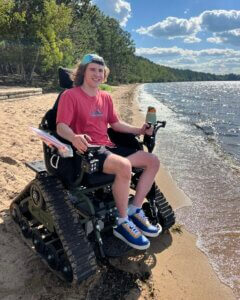
Mason on an Action Trackchair, an all-terrain wheelchair increasingly offered for rent at state parks around the country. Picture taken at McCarthy Beach State Park.
A couple friends have a consulting business called Dovetail Trail Consulting. They advocate for accessibility by educating land managers and the outdoor industry on the laws that already support people with disabilities on trails. For example, did you know trail signage should include specific details like trail width, cross slope, and running slope? Displaying that information on trail signs is important because it allows users, including those using mobility devices, to make informed decisions about where and how they choose to recreate. Dovetail also helps land managers notice the “small” things that can become the biggest barriers for some users: a gate that’s a few inches too narrow, or a single boulder or tree that pinches the trail just enough to make it impassable for adaptive equipment. Our adaptive mountain bikes are wider than normal bikes, and some of them can’t handle the same side slopes, or narrow passageways through trees.
There are also some common misconceptions around the distinction between e-bikes and battery-powered mobility devices. While they’re often lumped together, they actually occupy different lanes, legally speaking. Adaptive handcycles and mobility devices aren’t about gaining an advantage. They’re about access. For many wheelchair users, electric assist is the difference between participating in the outdoors at all and being excluded entirely. People see these electric handcycles and might not be in favor of the idea, because they don’t necessarily understand how important that technology can be for wheelchair users. It’s like, look, we need some extra assists — you try riding your bike for three hours with only your hands!
Ultimately, I really hope to see more people utilizing adaptive trail consultants, like Dovetail, to make the environment safely usable for people that need adaptive equipment. I also would like to see more adaptive equipment in state parks, because these pieces of equipment are so expensive — a lot of people don’t have their own adaptive tools. This will benefit everybody: elderly people in wheelchairs, people with walkers or those that have difficulty walking — everyone. With so much nature being destroyed, making sure that these places do still exist and are also accessible is so important, so that anybody can enjoy them.
- Connect with Mason Branstrator on Instagram, Facebook and TikTok
- Minnesota Department of Natural Resources adaptive equipment information
- Dovetail Trail Consulting
- Northland Adaptive Recreation
- “Connecting children of all abilities to nature play & therapeutic gardens” toolkit
- “Play for all: Breaking barriers to create inclusive childhoods,” a Finding Nature News feature
- “The dignity of risk: Creating a system of care to support children with disabilities in accessing nature,” a Finding Nature News Voices story
- “‘Naturally Inclusive’ outdoor experiences for children of all abilities,” a Finding Nature News feature
- Research Digest: Children with disabilities
-
Richard Louv
THE CRIMINALIZATION OF NATURAL PLAY: It's time to look for solutions
-
Network News
Cincinnati: From green schoolyards to city-wide green initiatives
-
Feature
A decade of ripples: What Nature Everywhere Communities reveal about systems change
-
Feature
Crossing invisible boundaries in the outdoors: A Q+A with Mason Branstrator
-
Feature
Forest bathing: Educators need nature connections, too