

Letting play come naturally: 6 ways to activate green schoolyards

When it comes to green schoolyards, kids know just what to do — play!
So where does “activation” come in? Before the kids even get there! It’s the process of making sure that these spaces are filled with nature-rich opportunities to explore, create and learn — and that educators and caregivers have the training and tools to feel comfortable letting kids enjoy them.
“Green schoolyards are more than just outdoor spaces,” says Brenda Kessler, Program Manager at the Children & Nature Network. “These are living classrooms where students learn by doing, exploring and connecting with the nature around them.”
Picture vegetable gardens full of produce that kids can pick and eat. Rain gardens that offer habitat for pollinators — and stormwater management. Winding paths, boulders and climbing logs that encourage adventure. Tree canopy for quiet contemplation, and outdoor classrooms where students can learn collaboratively.
Recess time is shrinking, time spent on unstructured outdoor play is dwindling, and screen time is rising. And yet, studies have shown that children are happier, more collaborative, more creative and more active in green schoolyards. Outdoor play not only increases motor skills but also helps children develop longer attention spans, a sense of independence and impulse control. And students with access to green schoolyards do better on standardized tests.
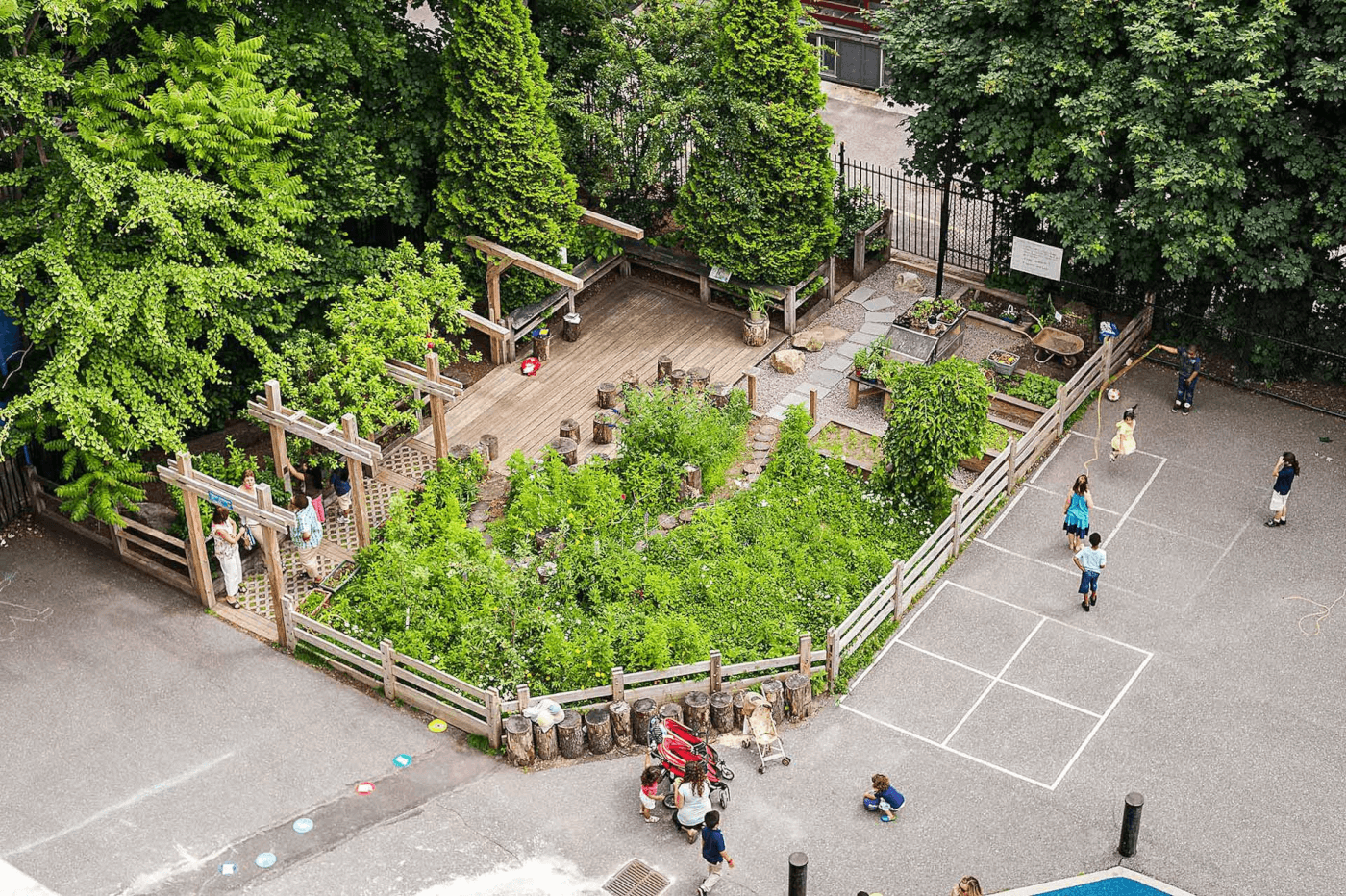
Boston Public Schools has integrated outdoor learning into nine urban schoolyards across the city. Courtesy of Christian Philips Photography.
As they’ve implemented green schoolyards across the U.S., our Nature Everywhere Communities have learned a thing or two about how to help school communities implement nature-rich features — so that children can do what they do best and enjoy all the benefits. Here are a few of their suggestions.
1. Ask kids what they’d like to see in a green schoolyard
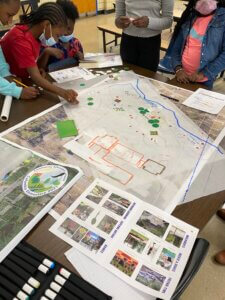
Students in Atlanta express their priorities and visions for their schoolyard. Photo courtesy of Trust for Public Land.
Give a kid a crayon, and they’ll draw you a picture of their dream playground. Kids are experts in play, and inviting them to the design table is a critical first step in activating a green schoolyard.
Nature Everywhere teams use a variety of methods to gather ideas from kids. They put up posters of green playspaces and let kids vote on features with stickers. They give children clay and ask them to build 3D models of their ideal schoolyard. And they use loose parts to help kids evoke the feelings they want to experience playing outdoors in nature.
In Michigan, the Grand Rapids Nature Everywhere Community team invited older youth to an event called KidSpeak, an opportunity to tell local leaders about their outdoor experiences and their hopes for the city’s parks and playgrounds.
“Kids are so excited to be involved and see that what they suggested is really happening.” – Lynn Heemstra, director of Our Community’s Children, Grand Rapids, Michigan
2. Design a green schoolyard that welcomes all children
Thoughtfully designed green schoolyards can help diminish disparities in access to both nature and play, ensuring that children of all ages, genders and abilities experience a true sense of belonging — and the many benefits of time spent outside.
Traditionally, boys tend to use more of the schoolyard as they play — and therefore tend to be more physically active. A growing body of research shows that incorporating green features that appeal to the way girls want to play — like woodlands, treehouses and forts, benches and climbing walls — increases their physical activity levels.
Similarly, green schoolyards can provide richer, more inclusive outdoor experiences for kids with disabilities. Natural spaces activate a range of senses and skills, while encouraging creativity, collaboration and contemplation. Balancing natural elements with accessible features, like swings that accommodate mobility devices, furthers inclusivity.
“Creating more opportunities for children with disabilities and the parents or caregivers who support them to spend time in nature through intentionally designed outdoor spaces, like inclusive play areas, is crucial.” – Mark Davison, Planning Manager for Boulder Parks & Recreation, Colorado, and partner on the Nature Everywhere Boulder team
3. Create an oasis of cooler air for longer play times — and climate resiliency
We know that green schoolyards can contribute to climate and community resilience by incorporating features that reduce heat, manage stormwater and improve air quality. But how do those features impact play?
In a study conducted in Austin, Texas, researchers found that green schoolyard features, like tree canopy, water and gardens, can substantially reduce the heat index in a play area. And, in that oasis of cooler air, kids play longer and harder.
“We’ve been able to disrupt the heat island effect by putting in trees that are 5 to 7 years old. They’re starting at around 7 to 10 feet high. They’re going to give you shade the day they get planted.” – Megan Allegretti, Director of Program Improvement for Oakland Unified School District
4. Make way for risky play with education — and maintenance plans
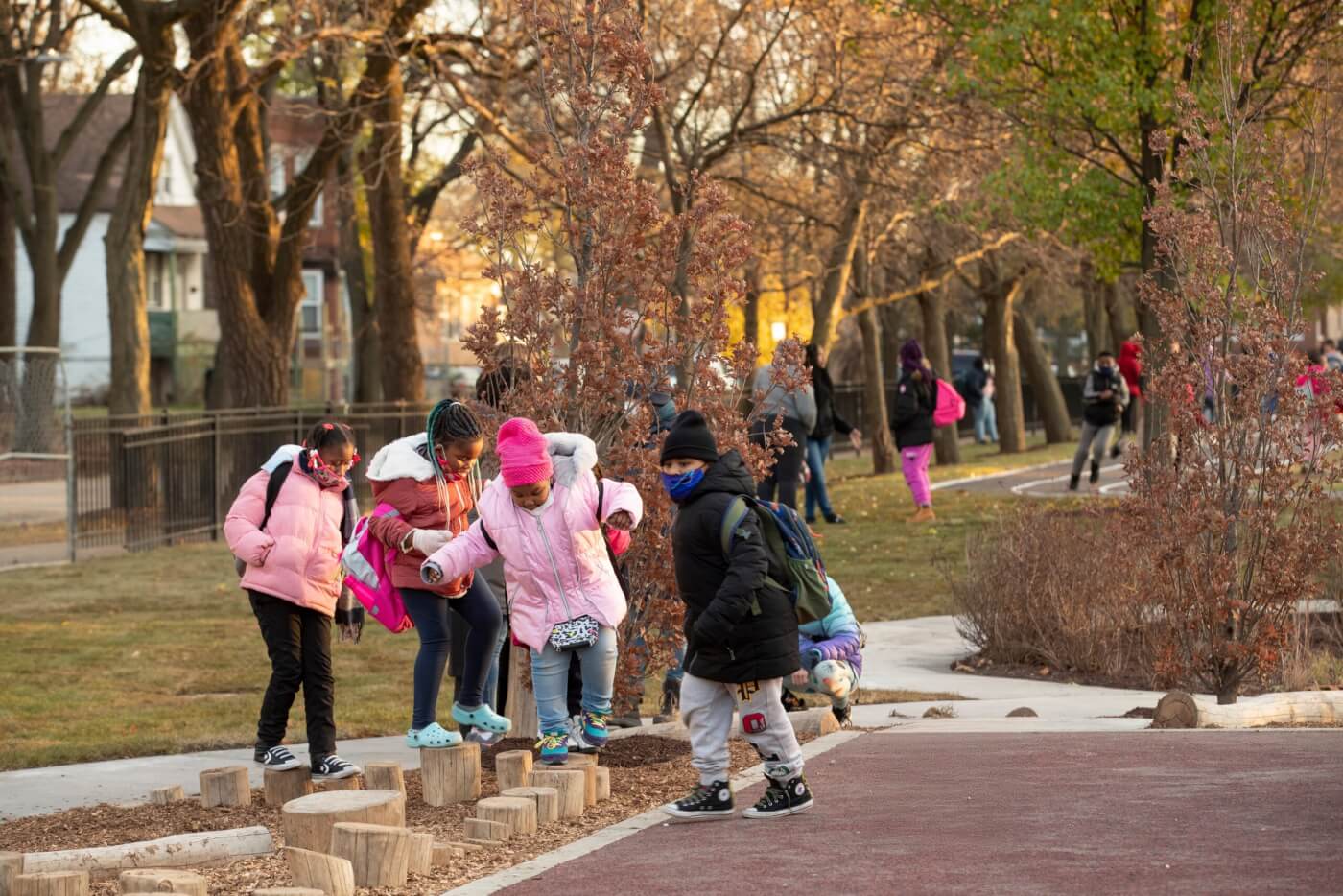
Leaping off boulders, balancing on a log, climbing trees — these are all examples of risky play. Risky play is an essential (and safe!) part of childhood development. But helping parents and school communities get on board can sometimes be a challenge.
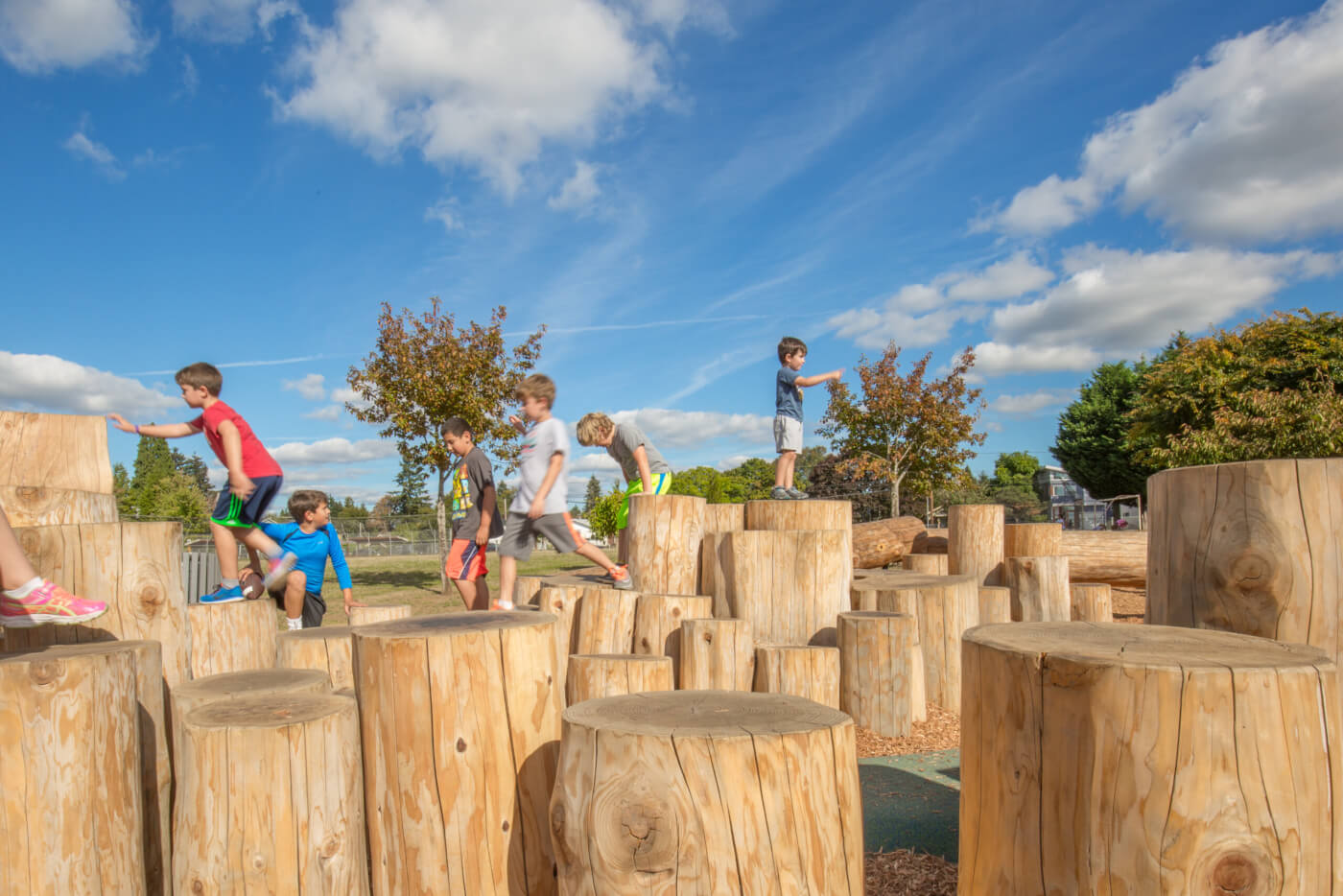
Students leap and scramble across logs on a green schoolyard at Lewis Elementary School.
Community engagement provides an opportunity to educate parents and educators. Inviting parents and school communities to visit existing green schoolyards allows them to see risky play in action. Similarly, it can build buy-in to share the research on how risky play can help children develop physical confidence, creativity, critical thinking skills, resilience and nature connection.
A strong maintenance plan can support risk management, enhancing safety — and public perception of safety. For example, the Nature Everywhere Community team from Providence, Rhode Island, has invested in a crew of Certified Playground Safety Inspectors, who complete weekly inspections to stay ahead of repairs. It’s working: Over a period of 10 years, no playground accidents have occurred in the community’s nature play areas.
5. Plant food and pollinator gardens
School gardens give students of all ages the opportunity to get their hands in the soil and connect with nature in a hands-on way. They foster awe and love of nature. And as outdoor learning spaces, they can facilitate a range of learning, from environmental science to social studies and math.
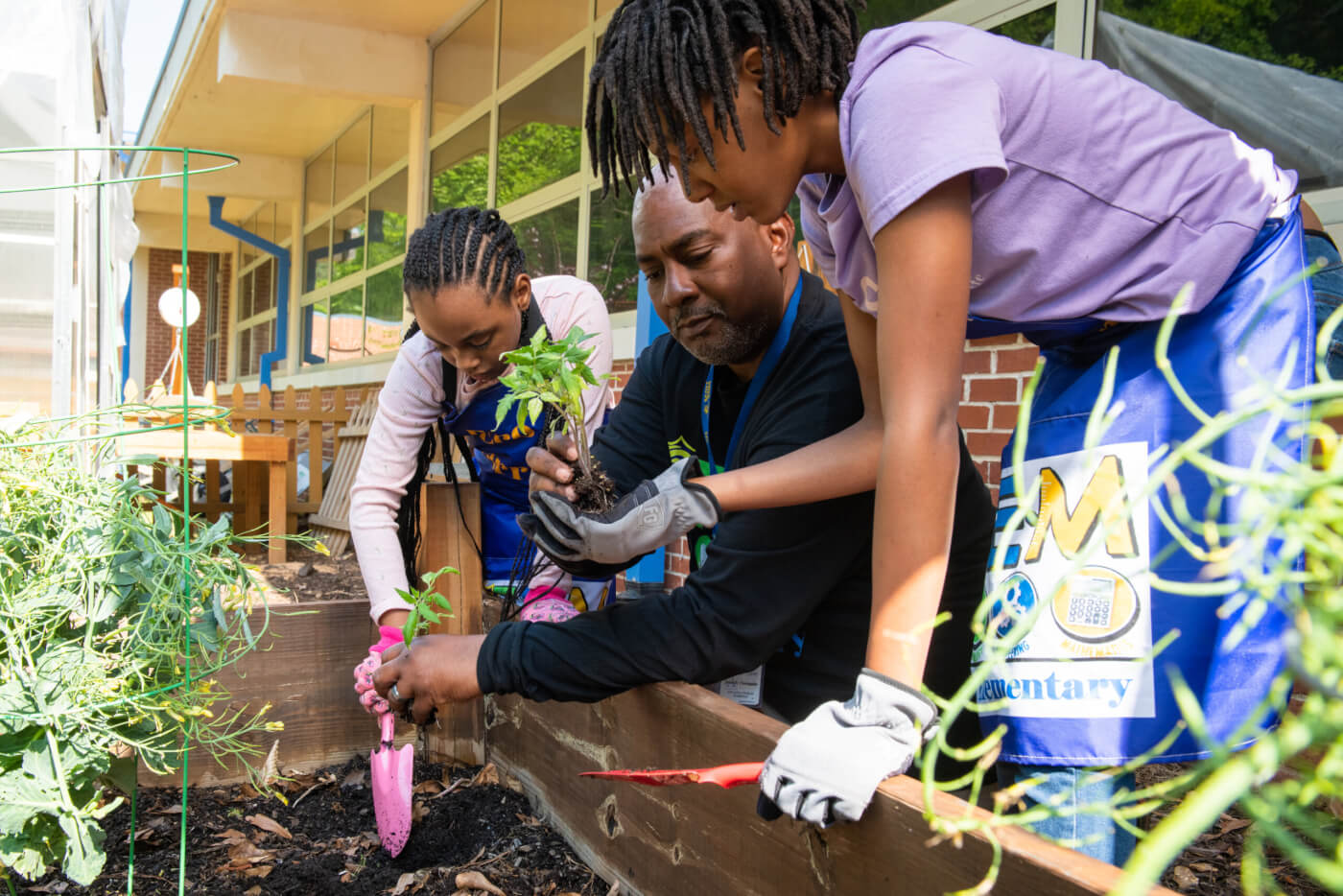
Students garden at Scott Elementary School in Atlanta, Georgia. Photo courtesy of Trust for Public Land & KABOOM!.
Working with Cities Connecting Children to Nature Austin and Central Texas School Garden Network, the Austin Independent Public School District (AISD) has installed more than 120 gardens. Pollinator gardens teem with monarchs, birds and other native wildlife. In food gardens, students plan, grow, harvest and eat fresh produce. In some cases, they manage CSAs and farmers market stalls. These students are learning about sustainable agriculture practices, nutrition and food systems — and, along the way, accessing a green pathway to jobs.
6. Make sure teachers feel comfortable in outdoor classrooms
Outdoor teacher training and lesson plans can help teachers figure out how to make a green schoolyard an extension of their classroom. Sometimes, it’s less about starting from scratch than moving existing lessons outside — like reading circles, show-and-tell, math or art — or partnering with local nonprofits that already provide outdoor education.
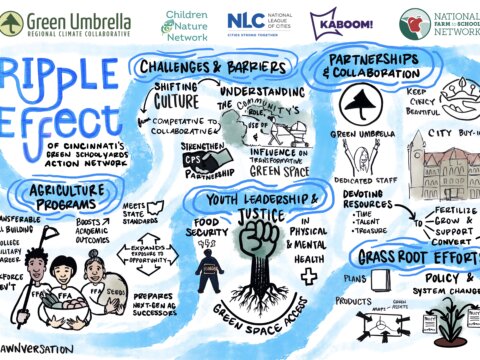
As part of Green Schoolyards Action Network (GSAN), Cincinnati Public Schools has partnered with local outdoor education nonprofits to develop environmental and STEAM education curricula for K-5 students. In addition, they’ve built teacher training modules that are eligible for continuing education credits and support experiential learning — so teachers feel more comfortable in green schoolyards.
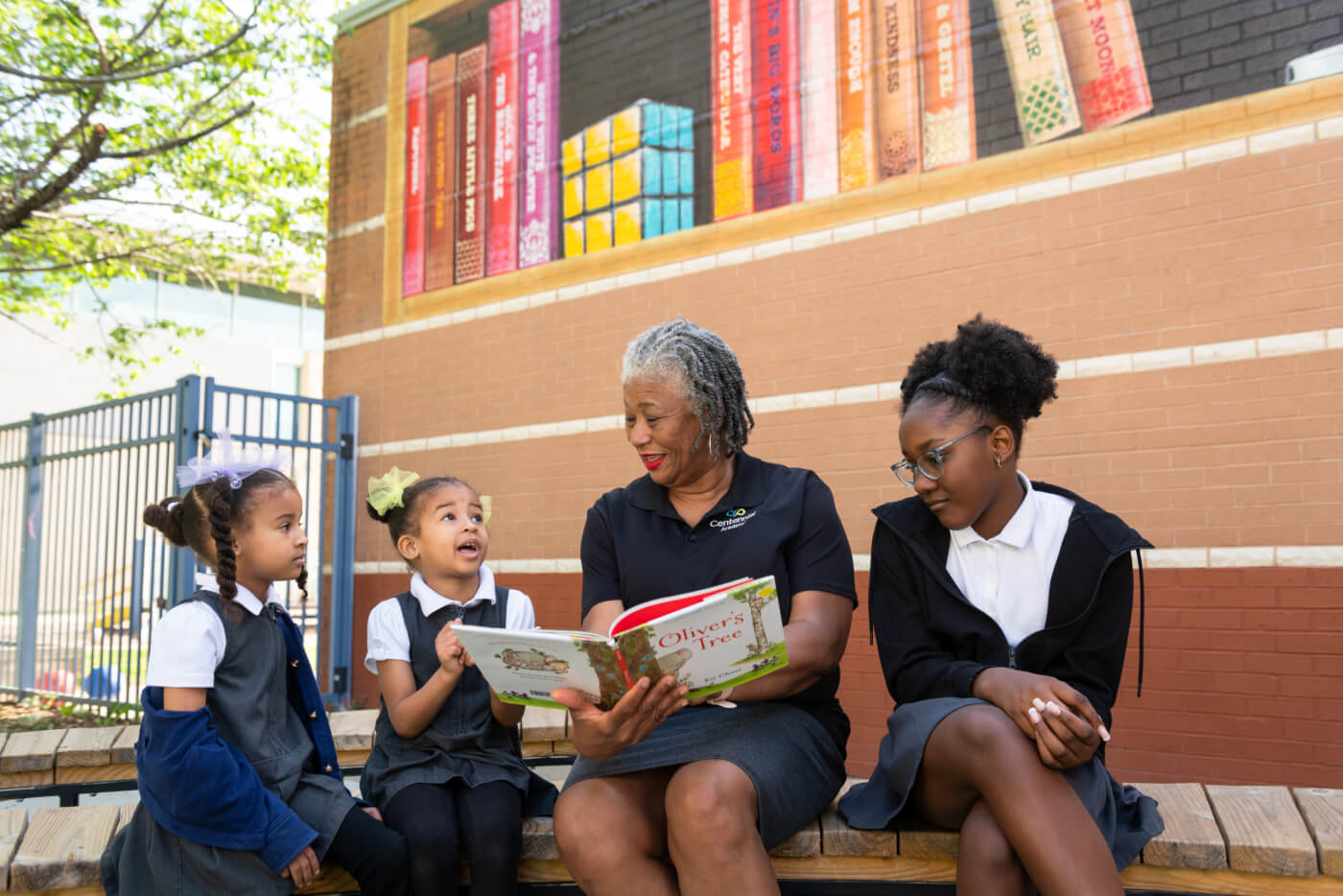
A teacher takes her students outside at Centennial Academy in Atlanta, Georgia. Photo courtesy of Trust for Public Land and KABOOM!.
Similarly, the Nature Everywhere Community team in Grand Rapids invested in an Outdoor Learning Coordinator, whose role is to help facilitate outdoor learning by building awareness of teaching resources. The city has also created a Schoolyard Features Inventory, a database of outdoor learning features — from trees to ponds — available to local teachers.
“While family involvement is invaluable to build community and conduct basic green schoolyard maintenance, without outside resources to fund garden educators or professional development for teachers, lower income schools are at a disadvantage.” – Tamar Barlev, Green Schoolyard Manager for San Francisco Unified School District
If there’s a theme running through this list, it’s the critical role that community partnerships and resource-sharing play in activating green schoolyards. An excellent example is the Green Schools Consortium of Milwaukee (GSCM). A team from Milwaukee, Wisconsin, who joined the CCCN national initiative in 2021, brings together educators, nonprofits and agencies to support the success of green schoolyards with professional development, shared resources — and the annual Green & Healthy Schools Conference, now in its ninth year.
This list also highlights that activation is not a single step, but a critical part of every step in bringing a green schoolyard to life. It involves community engagement, thoughtful design, training educators — and embedding a commitment to letting children explore, learn and play in natural environments into the very DNA of a school community.
By investing in strong activation strategies, cities are helping raise a generation that is connected to nature — and the joy and awe it inspires. “When we activate these spaces with intention — meaning we integrate green schoolyards features into the curriculum and encourage educators to bring their lessons outdoors — we’re not just enriching education,” says Kessler. “We’re cultivating curiosity, resilience and a deep-rooted sense of care for the environment.”
Green Schoolyards Resource Hub
Benefits of green schoolyards wheel, an infographic
Community and environmental benefits of green schoolyards, a Research Digest from October 2023
Rich Soil: The economic benefits of green schoolyards, a Finding Nature News story
In Flagstaff, green schoolyards sprout after climate-related disasters, a Finding Nature News story
In search of a greener schoolyard: As the planet heats up, green schoolyards offer a world of benefits, a Finding Nature News story
The Urgent case for green schoolyards during and after COVID, a Finding Nature News story
LEVELING THE PLAYING FIELD: Nature play for gender equity, a Finding Nature News story
-
Richard Louv
THE CRIMINALIZATION OF NATURAL PLAY: It's time to look for solutions
-
Network News
Cincinnati: From green schoolyards to city-wide green initiatives
-
Feature
A decade of ripples: What Nature Everywhere Communities reveal about systems change
-
Feature
Crossing invisible boundaries in the outdoors: A Q+A with Mason Branstrator
-
Feature
Forest bathing: Educators need nature connections, too