
Community Spotlight: Providence, Rhode Island

In Providence, Rhode Island, access to nature has become a defining feature of the city’s landscape and identity. Over the past decade, a partnership between the Providence Parks Department, the City’s Healthy Communities Office, Providence Public Schools and multiple community agencies has transformed parks and school grounds across the city into nearby spaces of nature exploration and play.
All 70 playgrounds in Providence have been renovated with natural elements, including rain gardens, nature trails and natural loose parts for play. And 11 schoolyards across the school district were transformed into outdoor classrooms for nature play and climate resilience. Five of those have joint-use agreements. All are places where children and families can connect with the outdoors close to home.
Much of this work began in 2014, when Providence was selected as one of seven inaugural cities to join the Cities Connecting Children to Nature (CCCN) initiative, a partnership of the Children & Nature Network and the National League of Cities. In 2024, the city was again chosen to join the expanded Nature Everywhere Communities initiative, building on a decade of progress and deepening its commitment to ensuring all children have access to nearby nature.
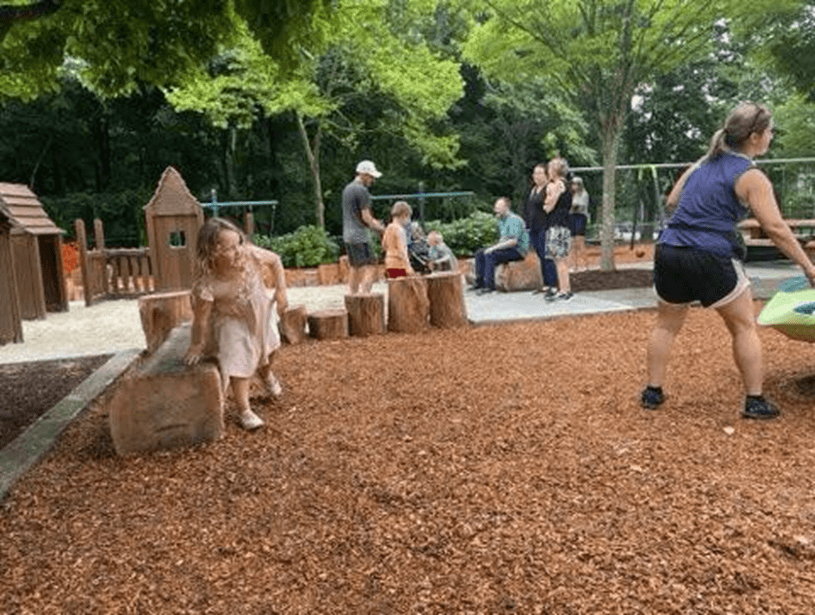
Peterson Park Playground serves as a community recreation space and as a green schoolyard for several urban independent schools in the area. Photo credit: Providence Parks Department.
“The City of Providence is an excellent example of what strong and collaborative local leaders can achieve with technical assistance and grant support,” said Priya Cook, Director of Community Engagement and Green Schoolyards. “Since its first implementation grant in 2014, Providence has transformed proof-of-concept ideas into demonstration sites throughout the city that model best practices in designing and programming spaces to connect children to nature.”
As a CCCN pilot city, Providence conducted a needs assessment and created an action plan to increase equity in children’s opportunities to interact with the natural world. School grounds and city parks were identified as key opportunities to create nature-based play areas, gathering spaces, and outdoor learning environments while advancing climate resilience goals.
One major outcome was the Providence Green Schoolyards Initiative, launched in 2019. More than $6 million has been invested to launch several green schoolyards across the city. The Providence Green Schoolyards Guide continues to help educators and facilities teams design outdoor classrooms and gardens that foster curiosity, health and environmental awareness. The City’s Teacher Institute helps educators integrate outdoor learning into their curricula, strengthening the connection between classrooms and community green spaces.
This vision continues today in the 2024 Providence Comprehensive Plan, which calls for a well-designed and maintained network of parks that “will connect children and families to nature, offer opportunities for free and open play, provide traditional and non-traditional recreation opportunities, connections to the arts, and be climate resilient.”
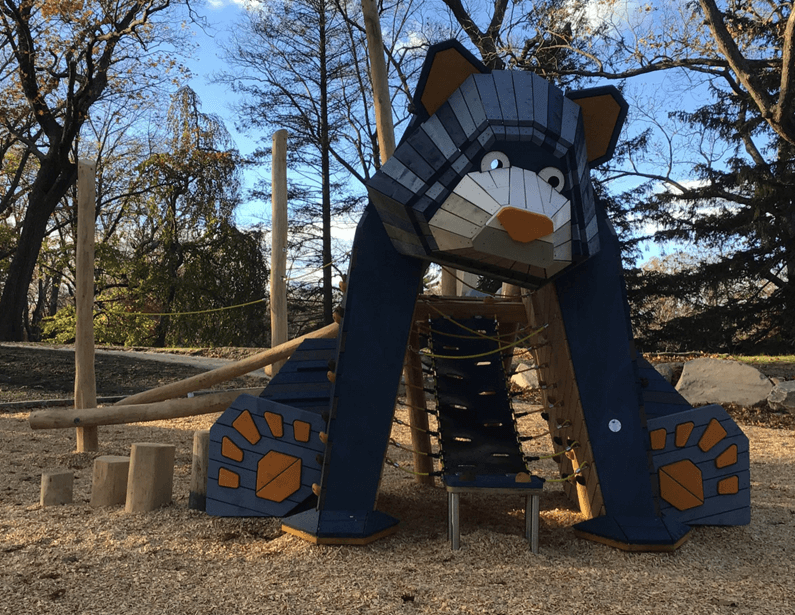
The playground, called Bear Ground, is themed around the park's history, when caged bears once lived there. Located at Roger Williams Park, the playspace integrates stormwater management with natural play elements.Photo Credit: Providence Parks Department.
Providence leveraged citywide climate adaptation policies to secure funding for nature exploration areas as part of its urban resilience efforts using federal climate resilience funding and local capital funds. This has allowed the city to not only meet its park and nature access goals, but also its climate resilience goals. An example: The city converted an underutilized parking lot into a thriving green play space with bioswales to manage stormwater.
Citywide integration of nature exploration areas has helped normalize nature play as a standard part of park and school grounds development. The work has also elevated the role of parks in climate adaptation and neighborhood health strategies.
Community engagement has been central from the start. While families initially favored traditional playgrounds, deeper dialogue revealed a shared desire for spaces that encouraged exploration and imagination. Once nature exploration areas were installed, residents discovered that these natural environments offered the same joy and challenge they valued, while enhancing children’s creativity, confidence and well-being.
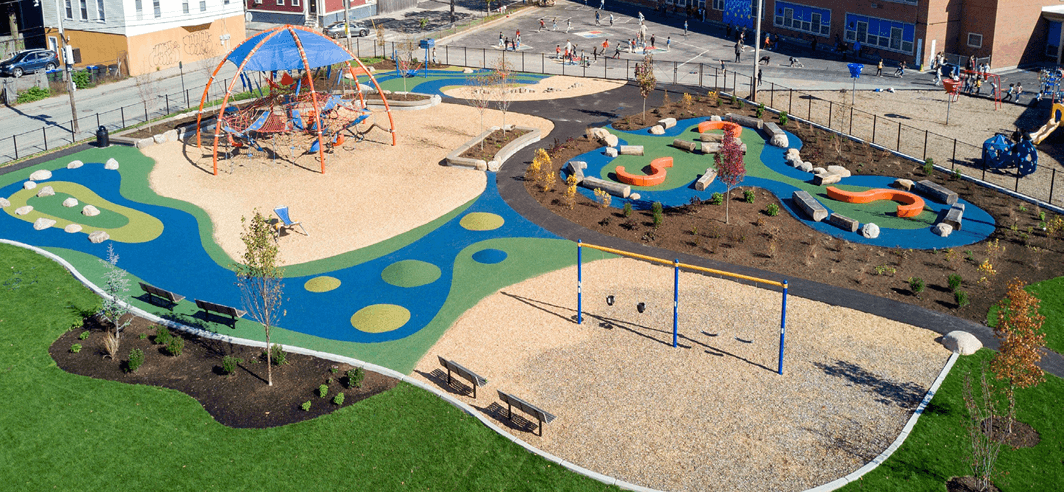
Harriet and Sayles Park and the Mary E. Fogarty Green Schoolyard Complex was renovated in 2023 to include outdoor classrooms, a multi-purpose field, an outdoor fitness area, a water park, new amenities and fencing.
This evolution in understanding has reshaped how the city approaches design and policy. The city’s commitment extends beyond construction. All park staff, from landscape crews to administrative teams, participate in regular training focused on nature-based play, inclusion and child development. Providence Parks’ Design Team prioritizes biodiversity and wildlife habitat throughout, thus reducing the need for mowing, establishing urban meadows and creating pollinator habitats.
Equity remains central to this approach, defined not only by where investments are made but how they reflect community need. The city uses GIS data overlays to identify neighborhoods with the lowest green space per capita and prioritizes engagement in those areas.
The city’s dedication to this work has earned recognition from the American Society of Landscape Architects, which honored the Parks Department for designing and building urban wildlife habitats and transforming outdated parks into authentic community spaces. These awards reflect not only design excellence but also a commitment to using public spaces as platforms for health, resilience and belonging.
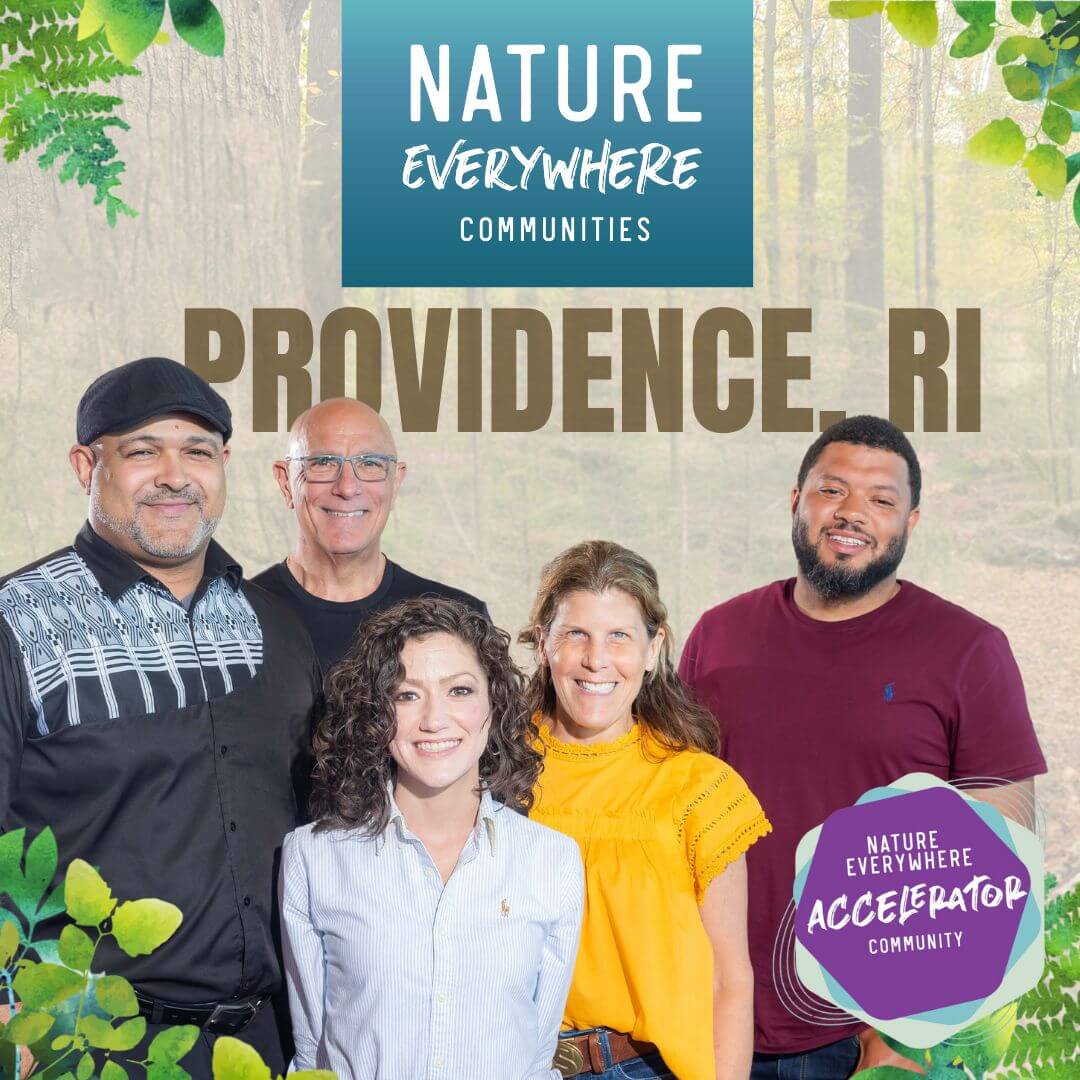
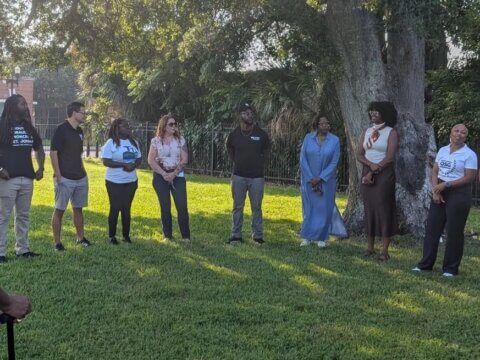
The Providence Nature Everywhere Communities team includes Silas Pinto (City of Providence, Diversity & Equity), John Arzoomanian (City of Providence, Public Property), Rachel Ferrara (City of Providence, Housing & Human Services), Rachel Colaiace (Providence Parks Department), and Victor Lopes (Providence Parks Department). Not featured, Carina Pinto de Chacon (Providence Public School District).
As Providence enters its next phase, the city is poised to deepen its role in demonstrating how equitable park design, sustained partnerships and community trust can create a greener, healthier and more resilient future for Providence’s children.
“Our team is looking at how we can expand our efforts at the intersection of nature access, climate resilience and play equity,” said Rachel Ferrara, Director of Human Services Division for the City of Providence, Housing & Human Services. “We can help every neighborhood design and sustain the kinds of spaces that make daily access to nature possible for all residents.”
Nature Everywhere Communities initiative
The Nature Everywhere Communities initiative was launched in November 2023 by the Children & Nature Network, National League of Cities and KABOOM!, with the goal of advancing equitable access to nature everywhere children live, learn and play in 100 communities by 2025.
The effort builds on lessons learned over the past nine years of providing technical assistance, training, resources and grants in more than 50 U.S. cities through Cities Connecting Children to Nature, a program specifically designed for municipal leaders. Nature Everywhere Communities is an expansion of this proven approach, as it welcomes leadership from both city and regional governments as well as school districts and the nonprofit, philanthropic and private sectors.
Through a competitive application process, communities are selected to join the Nature Everywhere Communities initiative. They receive assistance in strategic planning, technical support and start-up funding to develop and implement community-driven plans for connecting children to nature-based experiences and learning.
-
Richard Louv
THE "VITAMIN N" PRESCRIPTION - Some health professionals now recommending nature time for children and adults
-
Feature
A decade of ripples: What Nature Everywhere Communities reveal about systems change
-
Feature
Crossing invisible boundaries in the outdoors: A Q+A with Mason Branstrator
-
Feature
Forest bathing: Educators need nature connections, too
-
Feature
A future full of promise: Nature in early childhood