
Nature as Healer: Building a movement for children’s mental health in nature
It was the first five minutes of the Nature as Healer Roundtable. I had my computer, coffee and breakfast tacos ready to go on the desk in front of me. I adjusted my name card and grabbed a fidget toy off the table. I was ready to get to work. Jennifer Salinas, program manager at the Children & Nature Network, kicked off the program with a survey of the room.
“Which of you use nature-based practices in your work? Or, do you employ nature for your own self-care and healing? Stand up if so.” The room was split, with about half the participants standing up and half remaining in their seats.
“OK, now who here has experienced the healing power of nature? Who believes healing environments should exist in every neighborhood?” Every single person stood up.
This moment solidified for me how important the Nature as Healer initiative is, as well as how important the work is that we do at the Children & Nature Network.
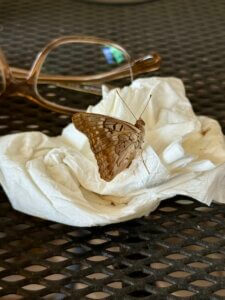
Nature’s healing powers are everywhere, if you remember to look.
Nature as Healer is a strategy for advancing children’s access to nature’s benefits, centering the ways in which time in nature supports mental health, recovery from trauma and overall well-being for children, families and communities. With children’s mental health in crisis, nature’s role in supporting young people’s well-being is more important than ever. Nature as Healer is our answer to this crisis.
Part of our broader Nature Everywhere strategy, Nature as Healer can be implemented in two different ways. At the organizational level, we support national and local organizations in embedding nature into their culture, staff wellness, direct services and family engagement practices. We did this in our work at Casey Family Programs, a foundation focused on foster care around the U.S., who also helped us co-develop the Nature as Healer strategy. At the community level, we bring together city agencies, nonprofits and cross-sector partners to create coordinated, place-based strategies for healing and resilience — as we did at the Roundtable. Together, these two pathways enable us to share nature’s mental health benefits with a wide range of partners, allowing us to reach deeply into organizations as well as broadly across communities.
The first Nature as Healer Community Roundtable brought together leaders from the Texas cities of San Antonio and Austin to explore how nature can serve as a catalyst for community healing and resilience. I was fortunate to attend, and I learned a lot during my time there — both as a staff member of the Children & Nature Network, but also as a parent and community member.
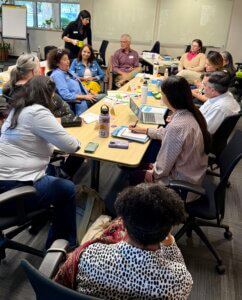
Cross-sector collaboration in action during a visioning activity at the Nature as Healer Roundtable.
At the Roundtable, leaders from agencies and organizations across both cities came together to imagine what it would look like to scale nature-based healing through cross-sector collaboration and shared commitment. It was amazing to see this goal in action, with professionals in the room from a variety of sectors including:
-
- public and mental health
- early childhood
- youth and family services
- parks planning
- community engagement
- culture based organizations
- child welfare
- policy and government
The diversity of sectors represented was amazing because we know that to create systems change, we need to build a diverse and wide-reaching network — people who care, with expertise and influence in different places, who can work together to develop (and implement) a shared strategy. That’s a big part of how we do our work at the Children & Nature Network, and we saw that come to life at the Roundtable: multi-layer partnerships being built between individuals and organizations — so that others can have their own kinship with nature.
When asked to define Nature as Healer, Jeanette Honermann of Texas Audubon, who attended the Roundtable, gave a place-based response that spanned the diversity and complexity of all of these relationships.
“‘Nature as Healer’ means that the natural world — from the vastness of Big Bend National Park to the gentle flow of the San Antonio River in my front yard — serves as an accessible, non-judgmental and inherently restorative presence. It is a place where our nervous systems can literally downshift. It’s the quiet knowledge that the rhythm of the seasons, the sound of water, or the feeling of sunlight filtering through the trees can calm anxiety, reduce stress, and offer a feeling of perspective and grounding that often gets lost in the noise of modern life. It’s not just part of a cure, but a constant resource for resilience and renewal.” — Jeanette Honermann, Texas Audubon
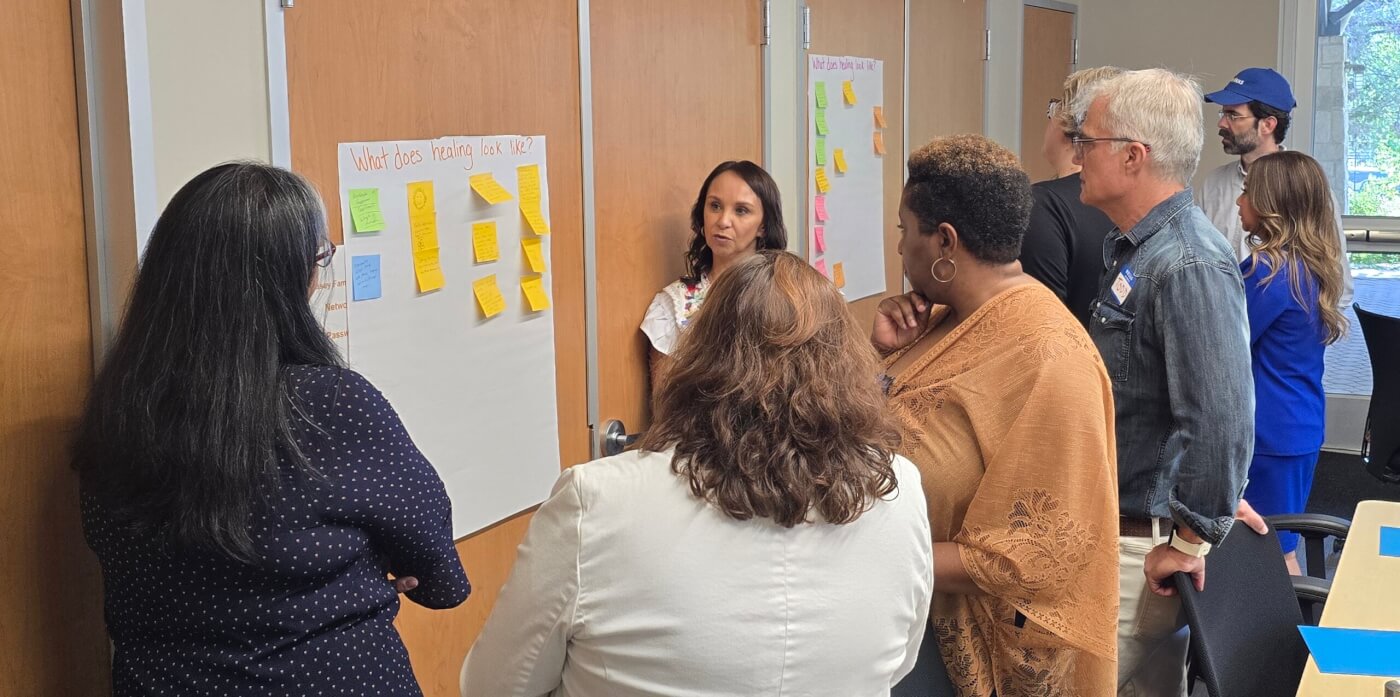
Josie Gutierrez, San Antonio & Texas Regional Coordinator for Latino Outdoors, shares what healing looks like to her.
Removing barriers — and making magic
To get us grounded in the big picture, Georgia Gempler, Health & Wellbeing Program Manager at the National League of Cities, presented on the social determinants of health. This is a fancy way of saying that social factors, such as where you live and work, can determine how healthy you are. In other words, city leaders are really health leaders. Of course, nature plays a key role in social determinants of health: nature connection significantly influences well-being by improving mood, reducing stress, enhancing cognitive function, promoting physical activity and providing social benefits.
I later learned that this notion of connecting nature with social determinants is a new, emerging concept resulting from the partnership between the Children & Nature Network and the National League of Cities. I was surprised by this since the concept seems so obvious. Access to green spaces is often unevenly distributed, with communities of color and those from lower socioeconomic groups having the least amount of access to safe, high-quality natural spaces. This, in turn, leads to health disparities within these same communities. By advancing nature-based solutions, communities can advance health equity and racial equity at the same time.
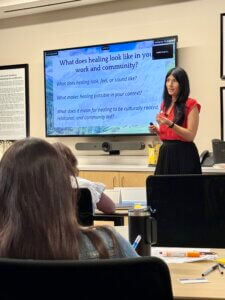
Jennifer Salinas led the Nature as Healer Roundtable.
Another exercise, facilitated by Salinas, asked participants to name the barriers that can make this work difficult. Some barriers were familiar ones, like parents and caregivers lacking time and energy (as a mom, I’m very aware of this one!). But there were other barriers that I didn’t have on my radar — like inadequate public transportation preventing people from accessing parks and green space, home builders tearing down trees and burning fertilizers causing respiratory issues, and local nature being unsafe for a variety of reasons (poor lighting, old structures, lack of funding).
In addition to identifying barriers, the group discussed conditions for success — the things that make our work to connect children with nature possible. We discussed the importance of shifting focus from today’s polarizing political extremes to an emphasis on shared goals and common language. Everyone wants kids to be healthy, and we got creative with it: dreaming up educational campaigns to share the benefits of nature with frontline professionals that serve children — nurses, teachers, bus drivers and lunch aides — as well as addressing the whole family unit, not just the child. I loved the out-of-the-box thinking that emerged from our cross-sector conversation — a fantastic example of the magic that happens when we bring Nature as Healer to communities.
More magic happened during our visioning conversation, where we envisioned a community-wide “healing coalition.” We identified opportunities for cities and agencies to invest in green spaces, transportation and policies that expand access to healing environments, setting the stage for further collaboration in the future.
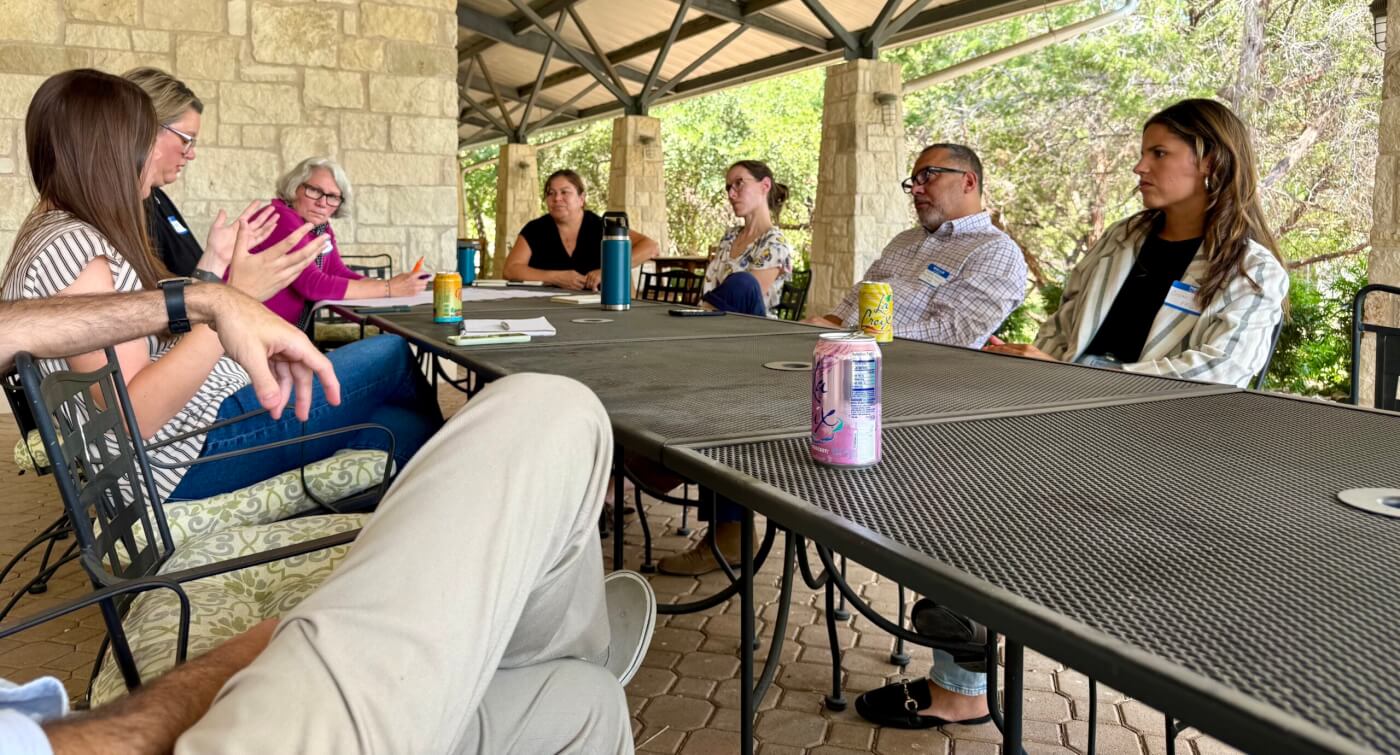
During a breakout, Roundtable participants from Austin discussed what Nature as Healer could look like in their city.
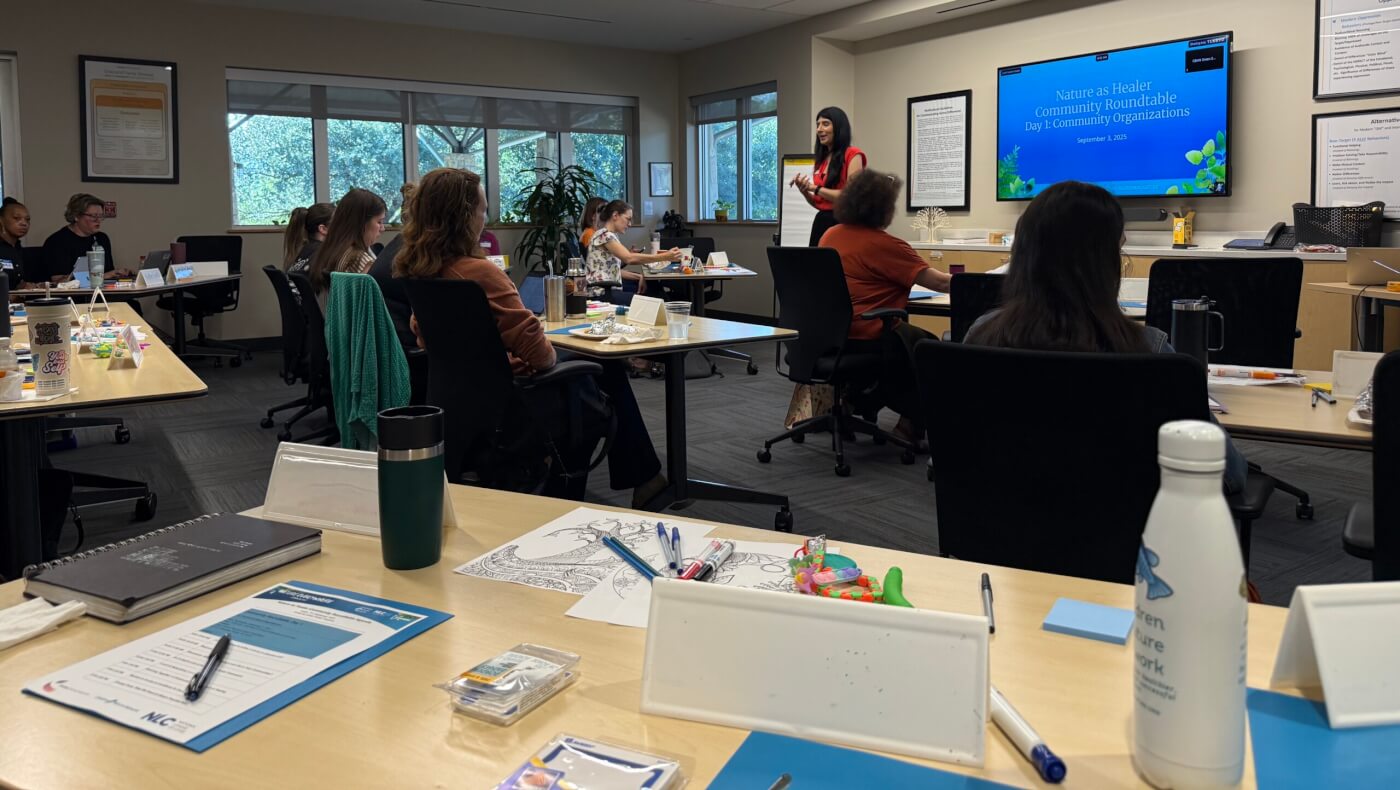
Ready to learn on Day 1 of the Roundtable.
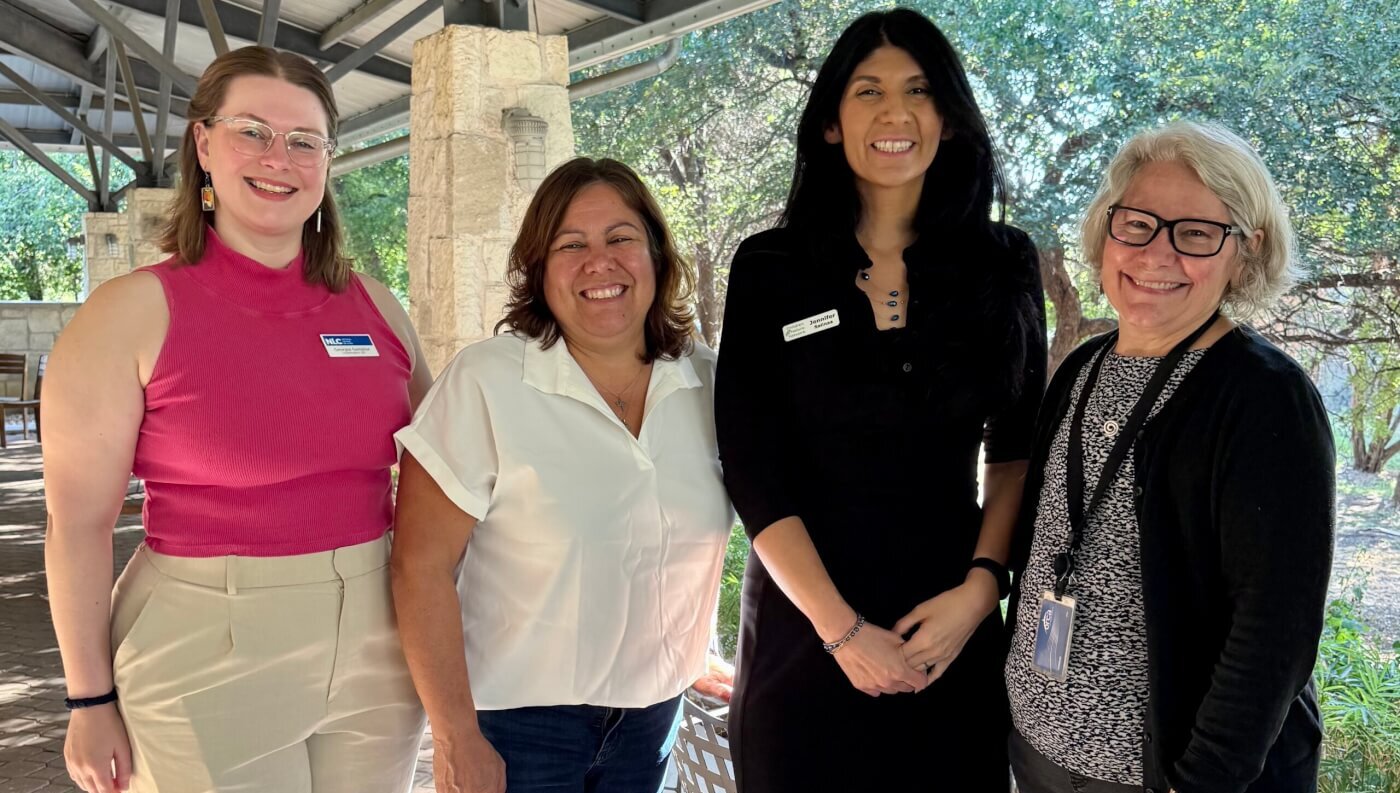
The dream team. Georgia Gempler of the National League of Cities, Monica Lopez Magee and Jen Salinas of the Children & Nature Network, Patsy Sellars of Casey Family Programs.
The two days were informative, inspirational and at times intense. They laid a strong foundation for additional coalition-building, infrastructure and systems alignment. In the months ahead, some participants will join a Community of Practice to sustain collaboration, share learning and advance lasting community change. And, outside of Texas, the work piloted at this Roundtable will help shape a community model that can inspire and inform future efforts across the country.
Are you part of an organization or community that could benefit from integrating nature’s role in mental health and well-being into your work? Reach out to Jennifer Salinas, jennifer@childrenandnature.org, to learn more.
1 Comment
Submit a Comment
Nature helps children recover from Adverse Childhood Experiences, toolkit
A natural remedy: For social workers striving to help keep kids out of foster care, nature-based interventions can be a powerful tool, a Finding Nature News story
4 Ways to Practice Self-Care in Nature, infographic
Research Digest: Therapeutic Use of Nature
Research Digest: Nature, Trauma, and Displacement
Research Digest: Nature and Resilience
Research Digest: Adolescent Mental Health and Nature Engagement
Bibliography: Nature’s Role in Promoting Resilience, Regulation and Recovery
-
Richard Louv
VITAMIN N FOR THE SOUL: How Nature Can Nourish the Spirit of Children and Adults
-
Network News
Prescribe Outside: Progress moves at the speed of trust in Philadelphia
-
Voices
Nature to screens: How our built environment set the stage for the anxious generation
-
Feature
We’re all looking for the same moon
-
Feature
Forest bathing: Educators need nature connections, too
I just read Kristy Omelianuk’s article with great interest. It dovetails perfectly with the course in Children’s Literature I am currently teaching at UTA: Nature and the Child.
“Nurturing nature” is a two-way street we follow from the early 20th century to the eco-novel and finish with the climate novel. The latter genre is most poignant when it comes to the question of what a child can do now to nurture nature.
I am relieved to see that the novelists writing for children are responding to the urgency with great honesty while also providing hope and comfort to children who are experiencing economic-anxiety.
I would love to see public libraries join forces with local nature preserves and community gardens.