


Rest and recreate in peace: Nature connection in cemeteries

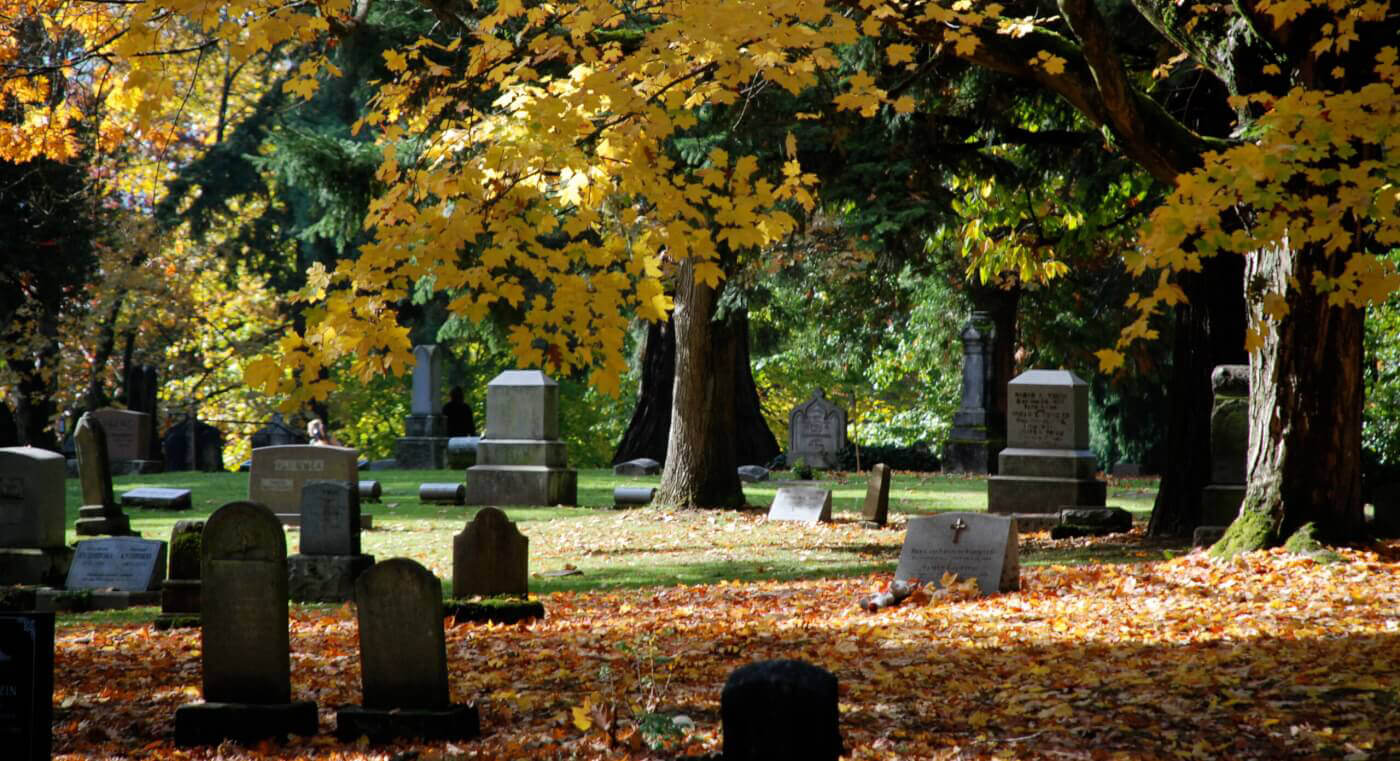
Imagine you’re out for a stroll with your family. It’s late October, and you’re walking without a destination, gleefully kicking through fallen leaves until — suddenly — you’re standing in front of a cemetery. Your children urge you inside; Halloween is right around the corner, and they’re craving something spooky. Maybe there’s a creaky iron gate, maybe a distant crow caws and the air turns cold and damp. You take your childrens’ hands and enter, only to find … a beautiful park!
“People don’t think of cemeteries as being natural spaces, but they are,” says Hannah Erickson, parks and nature content specialist for Metro, which provides regional governance for the greater metropolitan area of Portland, Oregon — including 14 historic cemeteries. “They’re just very special places. Places of sadness and memory, true, but there’s also a lot of beauty and joy there too, and when you visit, you’re connecting to the history of a place in a different way.”
Garden cemeteries, or rural cemeteries, became popular in the 19th century. Designed as an antidote to the crowded graveyards found in urban churchyards, they were picturesque, welcoming — and often private.
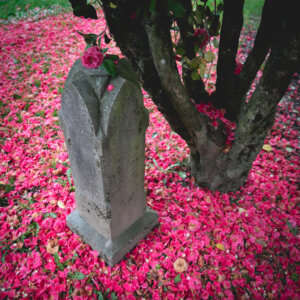
Cemeteries are often home to flower gardens and blooming trees and bushes, like this camellia in Lone Fir Cemetery, Portland, Oregon. Photo courtesy of Metro.
Metro’s historic cemeteries were built by early European settlers of the mid-1800s, who set aside acres of land to create family and community plots. “Most of these cemeteries, when they were created, were way out in the country,” Erikson says. “Urban environments have grown around them, but inside the cemetery, you can still feel that sense of hush. It’s very intimate to be in a space with peoples’ graves, and often they are lovely pools of serenity and contemplation.”
According to Keith Eggener, author of “Cemeteries,” early rural garden cemeteries were once important public spaces. Built at a time when there weren’t many public parks or botanical gardens in American cities, cemeteries offered not only spiritual respite but also recreation — a place to look at sculpture and horticultural art, to picnic, and even to indulge in more raucous activities, like carriage races and hunting. Cemeteries were so popular, many published visitor guides and rules. (No horses on the headstones, please! See our “Do’s and Don’ts” guide below for more.)
Though cemeteries’ recreational role dwindled over time, they’ve remained — like so many ghosts — right in our midst. Now studies show a renewed interest in visiting them to enjoy their nature, wildlife and solitude, as well as to explore the history buried deep in their storied graves. Cemeteries around the country are enticing the living through their gates with events, classes and, yes, guides to help them make the most of the grounds. And as protected public outdoor spaces, they’re as pretty as ever.
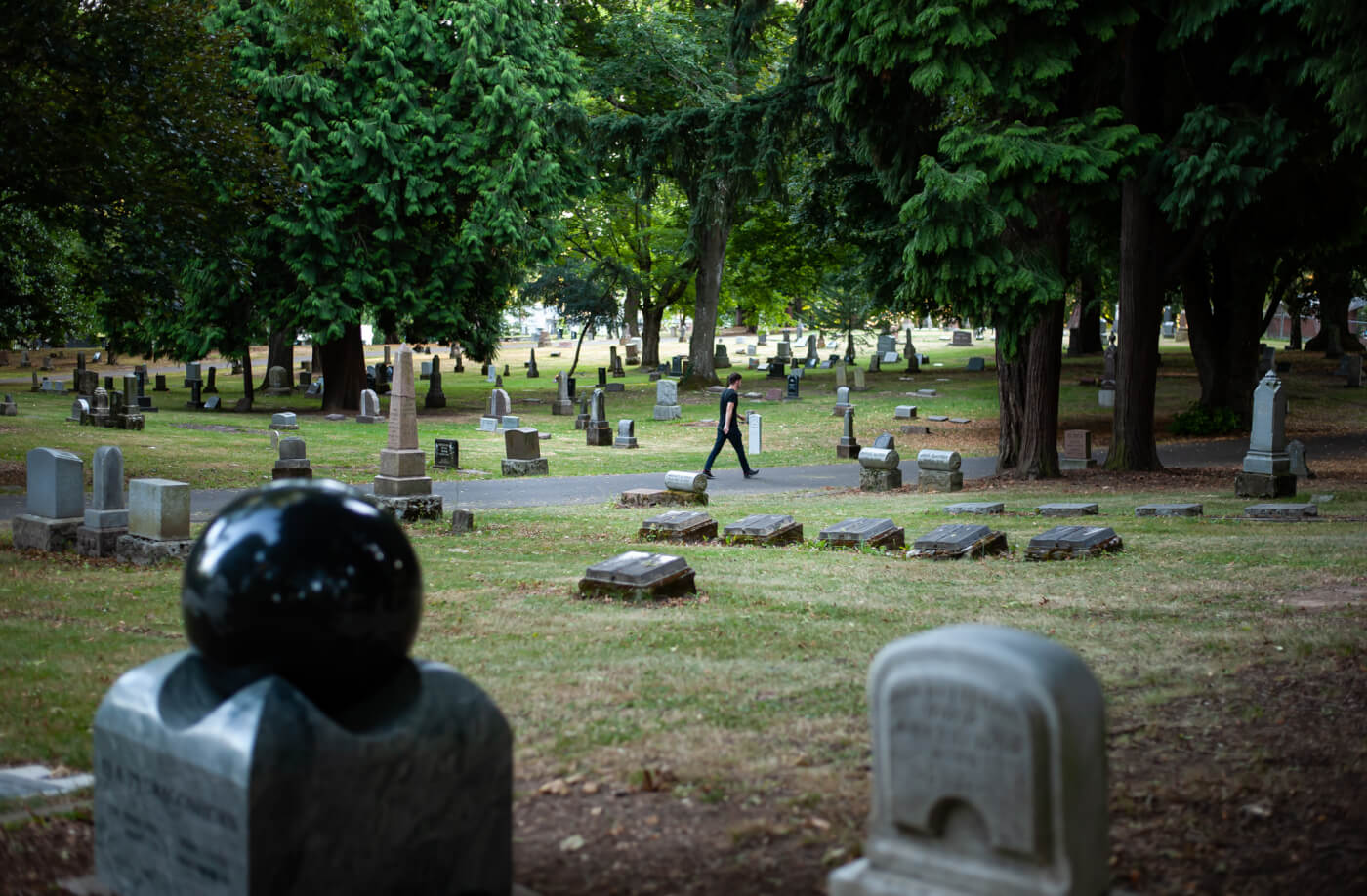
Portlanders use the paths at Lone Fir for walking and jogging. Photo courtesy of Metro.
In the past, it was common for people to plan trees in memory of loved ones. In fact, Lone Fir is Portland’s second largest arboretum with over 700 trees and 67 individual species. The historic cemetery provides free downloadable guides and maps for visitors, including a tree tour featuring heritage trees planted more than 150 years ago, like bigleaf maple, Douglas fir and incense cedar. According to the Lone Fir Field Guide, the old cemetery is also home to wildlife, including native Douglas squirrels, and such rarified birds as great horned owls and bald eagles. Also mentioned in the guide: the Pioneer Rose Garden. It contains 23 different roses, all grown from seeds that traveled on the Oregon Trail tucked in the apron pockets of pioneer women. Once, there were many such heritage rose gardens; now, it’s the last of its kind in the Pacific Northwest.
While garden cemeteries provide a haunted, er, enduring home for heritage plants, some have also been transformed by modern conservation practices. Consider Mount Olivet Cemetery in Washington, DC: Built in 1858, the 88-acre graveyard was the city’s first racially integrated cemetery — and sits atop a hill overlooking our national monuments. In 2017, amidst skyrocketing stormwater and sewage fees, Mount Olivet partnered with the Nature Conservancy to turn 44,000 square feet of impervious surfaces — hard, water-resistant artificial structures — into green infrastructure, like rain and pollinator gardens. In doing so, they reduced the cemetery’s water bill and improved the water quality of nearby rivers.
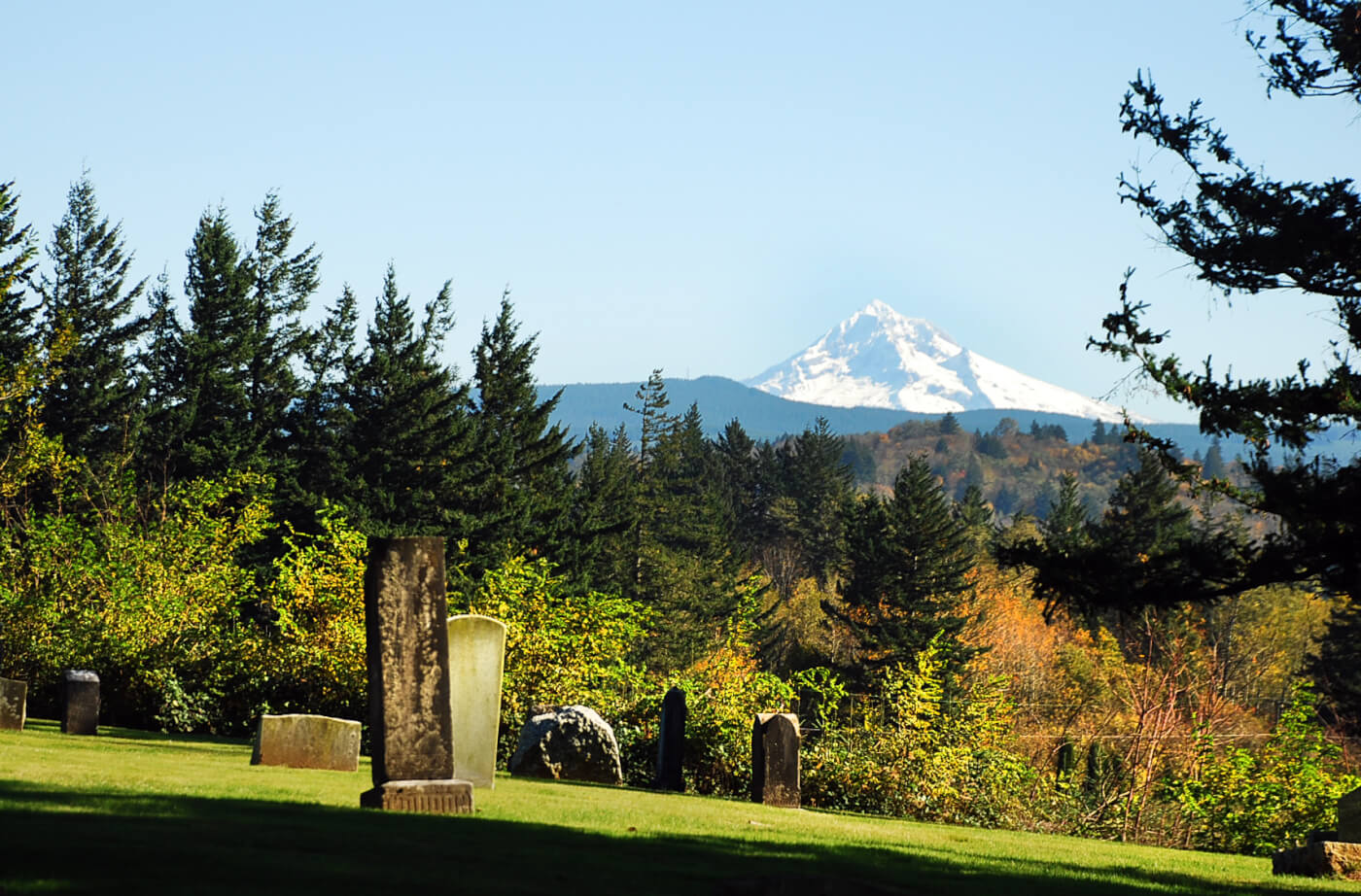
Cemetery with a view: Mount Hood, as seen from Mountain View Cemetery, Corbett, Oregon. Photo courtesy of Metro.
Erikson says Lone Fir has put a lot of energy into conservation projects too — conserving history, that is. “Cemeteries take you out of the books,” she says, “and give you this real, tactile experience.”
Friends of the Lone Fir Cemetery, a volunteer organization, offers guided history walking tours, including Stories in Stone, which looks at cemetery symbols and epitaphs. If you like cemeteries best when they are dark and full of long, eerie shadows, Lone Fir hostsweekly twilight tours of their most famous (and infamous!) occupants in October.
One of Erikson’s favorite cemetery events is gravestone tending, a volunteer activity that she says isn’t morbid at all. “It’s a lovely way for families to have a day together outdoors, caring for their community and connecting with other people,” she says. “Here in the Pacific Northwest, it’s pretty common for graves to get covered in moss. To make one legible again is a joy. You see people finish one, and they’re coated with grime, big grins on their faces — it just feels so good to have made this small difference.”
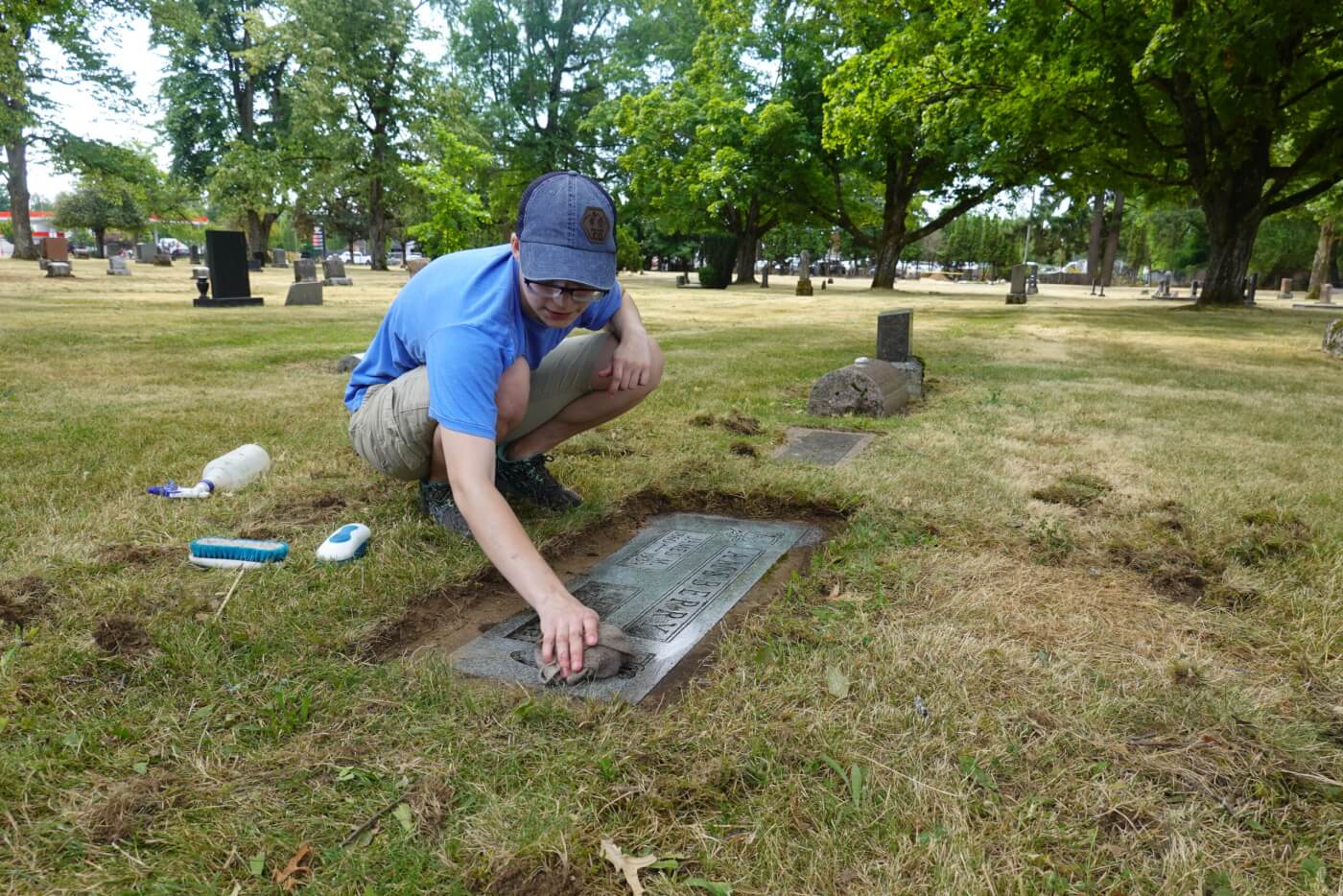
A volunteer washes graves at Multnomah Park Cemetery, Portland, Oregon. Photo courtesy of Metro.
Across the country, cemeteries offer seasonal public events that bring communities — both living and dead — together. At Lakewood Cemetery in Minneapolis, Minnesota, there’s a fall color festival to honor the changing season with live music, art and walking tours, but most of the events lean towards healing and contemplation. The cemetery’s calendar is chockablock with local artists and musicians offering everything from tea and grief ceremonies to labyrinth workshops to ancestral connection through traditional African music.
Okay, okay, so many fun and restorative events! But what if you just want to take the kids on an adventure in the cemetery? Here are some ideas and, in keeping with historical guides, a few rules.
- Check in at the visitor center or website: Garden cemeteries often offer maps and self-guided history and nature tours.
- Observe nature and watch critters: Cemeteries are a great place to see heritage trees and plants and to enjoy a little bird- and wildlife-watching.
- Read the symbols: Cemetery statuary are full of hidden meanings — personal, organizational, religious and more. There are many published guides to burial symbols, but it’s also fun just to notice them and make up your own stories.
- Picnic: Many cemeteries offer sweet benches and shady picnic spots. If you spread a blanket on the ground, just make sure it’s not on someone’s grave.
- Make grave rubbings: A gentle rubbing of a tombstone or statuary makes a lovely memento. Out of respect for living relatives, Erickson recommends avoiding graves less than 50 years old.
- Have a scavenger hunt: Fun categories include: people with streets named after them, languages, oldest or youngest person, statuary, famous people, amazing epitaphs and of course, different plants and wildlife.
Things NOT to do in a cemetery
- Don’t bring your pets: To protect the graves and grounds, don’t bring pets unless you have a service animal — and then keep them on leash and on paths.
- Don’t walk on graves: For many cultures, stepping on a grave is considered a violation, so try to be careful as you wander through the cemetery.
- Don’t climb on mausoleums or statuary: It can be so tempting for children, especially on the grander mausoleums.
- Don’t take photos of graves less than 50 years old: Out of respect for living relatives, who might be hurt to see even an artful image a loved one’s grave on social media.
- Don’t DIY grave-tend: It’s better to clean graves with cemetery staff, so you don’t accidentally damage old stonework.
- Don’t hide things: According to Erickson, there are already too many people digging around cemeteries in the hopes of finding lost treasure. Don’t egg them on!
Editor’s note: In writing and talking about this story, the Children & Nature Network staff has had a lot of fun sharing their favorite neighborhood cemeteries. If you have one you love, tell us about it in the comments — and be sure to include what you like to do there.
2 Comments
Submit a Comment
-
Richard Louv
VITAMIN N FOR THE SOUL: How Nature Can Nourish the Spirit of Children and Adults
-
Network News
Prescribe Outside: Progress moves at the speed of trust in Philadelphia
-
Voices
Nature to screens: How our built environment set the stage for the anxious generation
-
Feature
We’re all looking for the same moon
-
Feature
Forest bathing: Educators need nature connections, too


I have beena dvocating for cemeteries as natural spaces for 15 years. They are especially critical as amphibian habitat as there are no cars at night when the amphibians come in big numbers to breed in tiny ponds. My Youtube channel Moshassuckcritters has about 2500 videos that are nearly all of wildlife in an urban cemetery
Hi Susan,
I have a cemetery near me in Middletown, CT. I have lead several nature connection walks there. They have many amazingly beautiful large tree. We have even done field trips for students from local elementary schools that were a combination of nature connection, learning about local history and the geology of the gravestones.
Your suggestions to make grave rubbing would benefit by adding a warning. In some states like CT (where I live) it is a class D felony to do grave rubbings with out written permission. I think this is true in MA, NH and some other states. A number of towns in VT have also banned grave rubbing without written permission from particular officials.
There is more information why CT banned grave rubbing at https://ctgravestones.org/instructive-articles/gravestone-rubbings/ Essentially the gravestones made of sandstone (e.g. Brownstone) can be seriously damaged by grave rubbing.
Thank you for the interesting article.
Lucy